
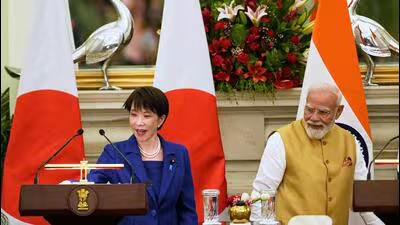
India on Friday responded to Pakistan’s protest over a reference to cross-border terrorism in an India-Japan joint statement by asserting that the document was self-explanatory and had addressed issues on which both countries have a “certain viewpoint”.
Event Context
The India-Japan joint statement, issued after a meeting in New Delhi between Prime Minister Narendra Modi and his Japanese counterpart Sanae Takaichi, had strongly condemned all forms of terrorism, “including cross-border terrorism from Pakistan”. In response, Pakistan’s foreign office made a “strong démarche” to express its concerns to Japan through diplomatic channels.
“I would say the joint statement that was adopted during the visit of the Prime Minister of Japan to India has several issues addressed, which are of bilateral nature, and also on issues on which we have a certain viewpoint. I would say that our joint statement is self-explanatory,” external affairs ministry spokesperson Randhir Jaiswal told a regular media briefing when he was asked about Pakistan’s action.
source
According to the joint statement, Modi and Takaichi also condemned the terrorist attack in Pahalgam in April 2025, which the UN Security Council Monitoring Team Report had linked to The Resistance Front (TRF), a front for Pakistan-based Lashkar-e-Taiba. They also condemned the terror incident in Delhi in November 2025, and called for perpetrators, organisers and financiers of the act to be brought to justice. They also called for concerted actions against UN-listed terror groups such as al-Qaeda, ISIS, LeT, Jaish-e-Mohammad (JeM) and their proxies.
Pakistan’s foreign office spokesperson said on Thursday that a “strong démarche” was made when Islamabad conveyed its concerns to Tokyo through diplomatic channels. “Whenever there is an engagement with India, India forces the inclusion of such references in its joint statements, not just with Japan but also with other countries,” the spokesperson told reporters.
Jaiswal responded to another question on Pakistan describing a warrant issued by an Indian court for LeT founder Hafiz Saeed in connection with the Pahalgam attack as a “politically motivated” action, saying that Pakistan has sponsored cross-border terrorism for decades and used it as an instrument of state policy.
Pakistan’s foreign office described the non-bailable warrant issued for Hafiz Saeed by a special National Investigation Agency (NIA) court in connection with the probe into the Pahalgam terror attack as a “baseless and politically motivated” effort to link Islamabad to the incident.
“The Pahalgam terror attack took several innocent lives. You all saw its barbarity. Our authorities have begun investigations in the matter and it continues,” Jaiswal said. “As far as cross-border terrorism is concerned, you are well aware of Pakistan’s decades-long sponsorship and support for it, as also its continued use as an instrument of state policy.”
In connection with Islamabad’s rejection of charges filed by the NIA against several Kashmiri separatist leaders in connection with an incident in 1996, Jaiswal said Pakistan “has no locus standi to comment on matters which are internal to India”.
