
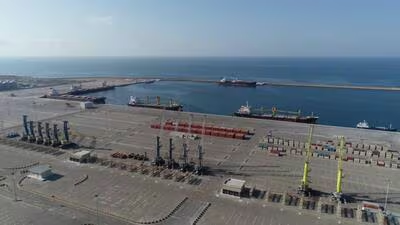
India on Friday urged countries involved in the conflict in West Asia not to target civilian infrastructure and clarified that the Shahid Beheshti terminal at Iran’s strategic Chabahar port, in which New Delhi has a stake, was not damaged in recent US air strikes.
Event Context
Team Analysis
Following the collapse of the Iran-US ceasefire over disputes regarding the regulation of shipping in the Strait of Hormuz, American forces have struck Chabahar port as part of their air strikes on Iranian infrastructure and strategic facilities, including Bandar Abbas port. US defence secretary Pete Hegseth posted an image of a maritime traffic control tower at Chabahar collapsing during a strike.
External affairs ministry spokesperson Randhir Jaiswal acknowledged reports of US attacks on Chabahar port and said: “But we can also tell you that the [Shahid Beheshti] terminal itself did not face any damage.”
The Shahid Beheshti terminal at Chabahar is being jointly developed by India and Iran as part of New Delhi’s plans to boost connectivity and trade ties with Afghanistan and Central Asia. Both countries intend to make Chabahar a key part of the International North-South Transport Corridor (INSTC).
A US waiver on Iran-related sanctions that impacted India’s involvement in developing Chabahar port ended in late April.
“There was a waiver which was given by the American side, that waiver got over some time back. Post that, we have been in discussion with relevant stakeholders as to how to take this particular issue forward,” Jaiswal said in response to a question at a regular media briefing.
Jaiswal reiterated India’s stated position that civilian infrastructure should not be targeted amid the hostilities in West Asia. “It has been a position that we have [taken] all along in this conflict, and otherwise in other situations as well, that civilian infrastructure should not be targeted under any circumstances,” he said.
Chabahar port in the Gulf of Oman provides India with direct access to Afghanistan, bypassing Pakistan, which denies access to land transit routes. The port also reduces dependence on traditional maritime chokepoints.
Speculation has arisen regarding the future of India’s operations at the Shahid Beheshti terminal of Chabahar port following the sudden winding up of India Ports Global Limited, the state-owned entity that was responsible for operations at the port since 2018, and the resignation late last year of Indian officials serving in the firm in the wake of US sanctions.
Budget documents have shown that the allocation for Chabahar, revised from ₹100 crore to ₹400 crore for 2025-26, was cut to nil for 2026-27.
