
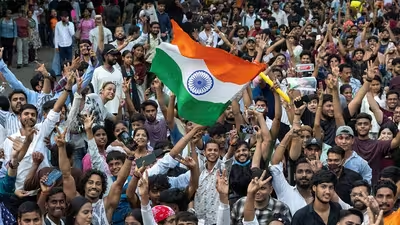
It’s been an eventful past few months for India. From memes on Instagram and X to memes on the streets of Jantar Mantar, a student movement, led by the Cockroach Janta Party, has resulted in the resignation of education minister, Dharmendra Pradhan – a rare occurrence in the 12 years of the Modi government, and the global media didn’t hold back in covering the event.
Event Context
What triggered these protests? A remark by Chief Justice of India Surya Kant referring to unemployed youth as “lazy cockroaches and parasites” and a paper leak that impacted 2.2 million students and claimed the lives of around 20 others.
The Cockroach Janta Party (CJP), which started as a satirical online outfit by Boston University graduate Abhijeet Dipke, went from mimicking the manifesto of a political party on its website to mobilising tens of thousands of India’s youth to demand accountability from the government.
A month of protesting at Jantar Mantar in New Delhi and across major Indian cities, the CJP withdrew its demonstrations on Saturday after Pradhan announced his decision to step down with an “anti-national” dig at the protest.
Through it all, India’s Gen Z found themselves at the centre of the movement and global headlines.
Across global media, many covered the CJP protest and Pradhan’s exit from the cabinet as a rare defeat for the Prime Minister Narendra Modi-led government. The BJP MP’s resignation also marks the first exit for the Modi government, which has been in power since 2014.
Apart from routine exits and losing seats in the Rajya Sabha and Lok Sabha, the previous exits from public pressure date back to 2017 and 2018.
Also Read | Here’s the last time a Union minister resigned under the Modi govt because of protests
“Gen Z responded with mock online tutorials that guided the prime minister on appropriate lighting, camera angle and script. Protests continued to spread to other cities around the country. Within a week, a resignation that had previously seemed impossible suddenly happened,” noted the publication.
What’s next for India?
On Pradhan’s exit, The Economist writes of a rare moment in Indian politics and how Gen Z “humbled a government.”
“India’s Gen Z may not be getting the education it deserves—but it has taught Mr Modi a lesson,” says the article.
In another story, the UK-based publication also noted that Gen Z’s knowledge and use of social media platforms and distrust for lapdog media showed the BJP government that even propaganda has its limits.
Similar sentiments are carried out in The New York Times, which writes that the protest, as well as Gen Z’s resilience after a day of facing police brutality, lathi-charges and tear gas, “caught Modi off guard.”
In a newsletter of the Financial Times, the publication noted after the July 20 crackdown on protestors, the chants turned towards the prime minister himself, for the first time in a long time.
The government’s attempt of “anti-nationals elements” did not work either, because majority of the protestors came from BJP voter base. Students and youth showed up everyday to demand accountability from a government that the people voted for.
“As far as I can recall, this is the first time a large cross-section of Indians has criticised the prime minister by name. Many of the protesting students come from the BJP’s core voter base — Hindu, middle-class households — some encouraged by their parents to protest, others defying their families to be there,” writes Veena Venugopal for FT.
In Al Jazeera, it was noted that the government’s social media tactics also failed, with Gen Z “flipping the script.”
“Gen Z is flipping its Hindu majoritarian party’s dominance on social platforms, weaponising against it the very tools the Bharatiya Janata Party has long relied on,” AJ noted, further citing protestors who stated for the first time, hating on Modi “became cool” after years of criminalising dissent.
While no mention is made, these comments also reflect the price that dissent activists and student leaders such as Umar Khalid and Sharjeel Imam had to pay as they mark their sixth year in jail, and no trial in sight.
In a BBC report, the CJP protest has been marked as a “movement the government did not see coming.”
Furthermore, July 20 crackdown, Gen Z pushed out videos, edits and made sure the evidence of the violence made it to every single person across the country, despite an internet shutdown across Central Delhi.
And through it all, “the protesters have undeniably shown a willingness to confront the state,” Political scientist Suhas Palshikar told the BBC.
Jawaharlal Nehru University Economist Surajit Mazumdar also told the British broadcaster that the movement points to something much larger than examination paper leaks.
The Economist also adds on the social media aspect of the protest, especially after a few front-facing videos of the Prime Minister were released. But Gen Z bought none of it and resorted to their usual language – memes, sarcasm and humour.
Also Read | ‘Kuchupuchu, resign kar do’: No lengthy speeches, GenZ are redefining language of protest with memes, sarcasm & costumes
Many placed tic-tac-toe on screenshots of the PM, while others dropped ideas for better angles and reading script without being detected.
Following Pradhan’s exit, Indian youth celebrated and marked the historic day. Hours later, Pralhad Joshi was named the next education minister.
Joshi, a five-time Member of Parliament and often described as the “blue-eyed boy” of the BJP’s top leadership, was given charge of the education ministry, in addition to his current portfolios as Union Minister for Consumer Affairs, Food and Public Distribution, and New and Renewable Energy.
Despite the protest coming to an end, India’s youth have observed and learned that the state can be and must be questioned as it now looks to work towards reclaiming the title of the “world’s largest democracy.”
