
How does one study an ocean that disappears for large parts of the year?
Event Context
For about six to eight months, the Central Arctic vanishes under about 6 ft of ice. Conditions are so extreme that the region has been nicknamed a polar desert because the air is so dry, and yet sudden dips in air pressure spawn brutal storms.
Because of how disruptive all this is, researchers still don’t know exactly how things work in the Central Arctic Ocean surrounding the North Pole. Exactly how do microbes, plankton, fish and other forms of marine life survive the winter? How differently have they evolved?
Enter Tara, a floating polar research station that looks like a flying saucer perched atop a buoy.
Setting sail today (July 19), the aluminium vessel will let a dozen scientists drift with the ice for over 500 days (or about 16 months, with two crew changes), in a rare uninterrupted mission that will study life, climate, ocean dynamics — and, vitally, changes in all three.
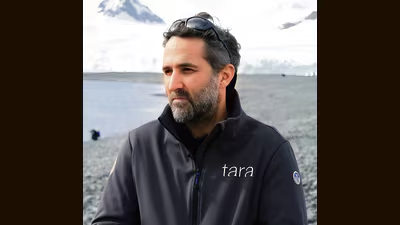
Among those leading the mission is French microbiologist Romain Troublé.
“There is a sense of urgency to describe the place before it changes,” says the 51-year-old, “and you can’t do it with satellites or summer-only surveys. You’ve got to sit there in the long-term and monitor the change.”
Troublé, who is also executive director of the French not-for-profit Tara Ocean Foundation, helped conceptualise the unique floating lab, which is set around a moon pool that lets scientists collect samples directly from the ocean.
For his ambitious efforts at envisioning and raising funds for Tara, Troublé recently won the Shackleton Medal for the Protection of the Polar Regions. Businessman Martin Brooks, founder of the prize, described him as “a modern-day explorer with ambitions and courage straight out of the Heroic Age of Shackleton.”
He started out wanting to explore new frontiers, Troublé says. This led him to take up competitive sailing, work with researchers to unearth woolly mammoth remains in Siberia’s permafrost, and join two polar expeditions.
Now the mission has changed from “What else is out there?” to “How can we protect these landscapes?”
Which doesn’t have to be dire news, he says. “Ecology, science and protecting the planet can be exciting, inspiring and can even be good business. That’s how we will have to see them, if we want people to truly embrace these ideas.”
***
Troublé isn’t all unbridled optimism.
“As a biologist, I know how profoundly life responds to its environment, and how a change of just one degree can alter everything,” he says. “When I look at the speed of what’s happening today, I think about my two children and the future I leave to them, and I ask myself: What else can I possibly do?”
That question sparked the idea for the Tara Polar Station, a decade ago.
The risk posed to our common heritage by all these factors “is one of the strong hooks for me,” Troublé says. “We are on a mission to describe, document and learn all we can from life here before it may disappear.”
Team Analysis
The shipbuilding company Constructions Mechanical Normandy then got to work, in 2023. The vessel’s oval hull was made using aluminium, which is corrosion-resistant and light enough to float — but notoriously difficult to weld. (Which is part of why the Normandy-based defence contractors had to be roped in.)
The polar station’s four decks now hold space for cabins, offices, laboratories, and a sauna, for the endless days of drifting in temperatures that can dip to -50 degrees Celsius. The craft is built to last, even in such extremes.
As the sea freezes, its unique shape will allow it to get frozen in without damage to the vessel, and then drift with the ice, driven by transpolar ocean currents.
The aim is to reuse Tara across 10 such expeditions between 2026 and 2046.
***
How does Troublé feel about the strains of such a mission on the people?
The greatest challenge was never the terrain or the weather, he admits. “The human dimension is by far the hardest.”
Teams overwintering at the Poles have reported meltdowns, paranoia, outbreaks of violence. Some are said to return with what is called the thousand-yard stare, a blank dissociation born of extreme isolation. “That’s why expeditions are led not by a single person but by team spirit, the shared vision and the collective effort.”
***
This effort has an added pressure: the race against time.
Match Outlook
Troublé’s aunt, the French fashion designer Agnes B, and her son, businessman Etienne Bourgois, had already set up the Tara Ocean Foundation, in 2003. Together, he and Bourgois now began to visualise a research vessel that would allow for dramatic advances in Arctic research; one that could be embedded in sea ice for long periods without being damaged by it.
It took 10 years to raise enough funds to start building the craft. Eventually, with help from government grants and corporate partnerships, Troublé raised £22 million.
The Arctic is currently warming three to four times faster than the global average. One way the Tara Polar Station plans to make the most of its time there is by sharing all its findings with laboratories across Europe. This could help researchers study how changes at the Poles stand to affect rising sea levels and global weather, including storm sizes and the tropical monsoon.
In addition, there are species, genes and proteins here that do not exist anywhere else on Earth. “When you realise how much these extreme environments have contributed to science, medicine and biotechnology, you realise they’re well worth protecting,” Troublé says.
Fish in polar waters, for instance, provided the first clues to how to produce antifreeze proteins (now used in organ preservation). That was in 1957. More recently, researchers have also identified powerful new antibiotic-producing bacterial strains in Antarctic marine invertebrates.
Meanwhile, commercial fishing fleets are already vying to use the route that would be opened up by the retreat of Arctic ice in summer. Shipping companies are looking to use it too. There is talk of mining the ocean beds that are set to be exposed for the first time.
So far, such activity has been banned in the Central Arctic Ocean until 2037. But that is only a decade from now.
