
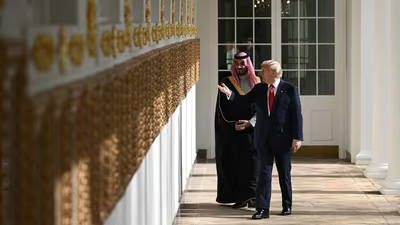
The US and Saudi Arabia on Wednesday signed a long-negotiated civil nuclear cooperation pact that clears the way for American companies to build reactors in the kingdom and. in a departure from Washington’s template, leaves a pathway for Riyadh to enrich uranium on its own soil.
Event Context
Leavitt said Trump had discussed the Abraham Accords with the Saudi leadership before, but that she was not aware of any conversation between the President and Crown Prince Mohammed bin Salman since the post. Asked whether Israeli Prime Minister Benjamin Netanyahu had requested that the condition be attached, she told reporters: “Not to my knowledge, no.”
Netanyahu’s office welcomed the move, saying in a statement that “Saudi Arabia’s joining of the Abraham Accords would be an historic leap forward for peace in the Middle East.”
Saudi Arabia has ruled out recognising Israel without progress towards Palestinian statehood, a position Israel’s current government has rejected.
HA Hellyer, senior associate fellow at the Royal United Services Institute, told AFP that if Washington “tries to force normalisation (of ties with Israel) on Riyadh, it’s not likely to work out very well”.
“Would Saudi decide to do a complete 180 on what it has declared for the past three years, or 30 years? Quite dubious,” Hellyer added.
Proponents in the US administration frame the agreement as commercially and strategically necessary.
Jennifer T Gordon, director of the Atlantic Council’s Nuclear Energy Policy Initiative, told AFP the deal was “a win for the United States over Russia and China”. Gordon argued that Riyadh would develop a nuclear programme in any case and the only real question was who would supply it.
Saudi security analyst Hesham Alghannam told AFP the pact was “a landmark achievement by any measure” for Riyadh.
“The alternative was not a Saudi Arabia without nuclear ambitions, it was a Saudi nuclear programme anchored in Russian or Chinese supply chains, with no American visibility, no commercial foothold for Westinghouse and no structural leverage,” he said.
Paul Dickman, chair of the American Nuclear Society’s External Affairs Committee, told AFP he was confident the deal would not create “additional proliferation challenges”, while stressing the need for transparency in the final text.
Team Analysis
Less than 24 hours later, though, US President Donald Trump added a condition to the agreement: it would only take effect, he said, if Saudi Arabia joined the Abraham Accords and normalised ties with Israel.
The pact was signed by US energy secretary Chris Wright and Saudi energy minister Prince Abdulaziz bin Salman, alongside a separate bilateral safeguards agreement. It was concluded under Section 123 of the US Atomic Energy Act, the standard framework for American civil nuclear cooperation agreements abroad. Washington has similar pacts with more than 50 countries, though the scope varies.
Reuters, citing the terms, reported that the deal runs about 30 years and is worth tens of billions of dollars. It permits Saudi Arabia to enrich uranium and reprocess spent nuclear fuel — both possible pathways to weapons-grade material. The concession is a substantial one, especially because the neighbouring United Arab Emirates (UAE) had foregone both when it signed a similar agreement with Washington in 2009.
The deal does not require Saudi Arabia to sign the International Atomic Energy Agency (IAEA)’s Additional Protocol, which allows snap inspections at undeclared sites — a departure from what Washington has demanded of Iran.
A two-year feasibility study will precede any enrichment facility. Reactors built under the pact would likely be American firm Westinghouse’s AP1000 model.
Congress has 90 session days to review the deal, with a two-thirds vote required to override a presidential veto.
Wright, in a statement, called the pact one that would “uphold the highest standards of nuclear safety and nonproliferation, while relying on the world’s best nuclear technology and scientists”. US secretary of state Marco Rubio told reporters in Manila that any deal “will have safeguards in place to ensure that it can’t be turned into a weapons programme”.
The full text of the agreement has not been released publicly as yet.
The Wall Street Journal reported that one provision would potentially allow US companies to build a uranium enrichment facility in Saudi Arabia; though the energy department made no mention of such a provision in its public statement. AFP reported that the department did not respond to queries when asked about it.
The IAEA, which would need to authorise verification measures, said it was awaiting a formal request from Washington and Riyadh, Reuters reported.
Kelsey Davenport, director for nonproliferation policy at the Arms Control Association, urged lawmakers on both sides of the aisle to “reject or modify” the deal, so as “not to open the door for nuclear proliferation in the Middle East even wider”, Reuters reported.
Allison Minor, director of the Atlantic Council’s Project for Middle East Integration, told AFP that “by keeping the door open for uranium enrichment inside Saudi Arabia, the nuclear deal sends a powerful message to Tehran”, and that the announcement should be read as part of “Riyadh’s broader strategy to managing the shockwaves of the Iran war”.
Match Outlook
In the same Truth Social post, Trump also asserted “there will be no enrichment of material” — a statement that was unclear in scope, as it did not specify whether he meant weapons-grade enrichment or ruled it out altogether.
White House press secretary Karoline Leavitt told reporters that if the kingdom did not join the accords, “the deal is off”. Saudi Arabia, which has not recognised Israel in view of Tel Aviv’s military operations in Palestine, has not commented publicly on Trump’s condition.
Also read: Explosions near Erbil airport, strikes on bases and rising Gulf tensions
The status of enrichment is further muddied by Trump’s Truth Social post, which said, “The Civil Nuclear Deal (There will be no enrichment of material!) … pertains only to non-military use such as the ones that Iran and UAE (and others) already have.”
Reuters noted that it was unclear whether Trump was referring to weapons-grade enrichment specifically — reactor fuel is typically enriched to up to 6% uranium-235, while weapons-grade material is roughly 90% — or ruling out enrichment altogether.
Also read: US-Iran war continues as oil tops $100 amid shipping route control measures
Trump’s Israel condition was not part of Wednesday’s announcement of the deal.
Alexander Bollfrass of the International Institute for Strategic Studies in London told AP that the “revolutionary aspect of this agreement is that the United States is not asking Saudi Arabia to abide by the highest possible safeguards, internationally monitored safeguards that are standard and are available today, but instead is willing to at least theoretically transfer highly sensitive technology without the same level of oversight that one would expect.”
Henry Sokolski, executive director of the Nonproliferation Policy Education Center, told Bloomberg the administration was “pushing the magical thinking” that safeguards would prevent Saudi enrichment for weapons. “In fact, no protection exists,” he said.
In Congress, opposition ran across party lines. Senator Edward Markey, a Democrat, said the deal would let “a belligerent and authoritarian nation” develop nuclear weapons technology under the cover of a war being fought over Iran’s programme.
“This deal would make us all less safe,” he said.
Senator Bernie Sanders, in a post on X, called the arrangement “absurd”, writing that Trump “claims his war on Iran is about stopping an authoritarian country from enriching nuclear fuel. Now he’s letting his best friends in Saudi Arabia … do exactly that”.
Senator Chris Murphy, a Democrat, said on X the agreement “will set off a nuclear race in the region, further disincentivising Iran from limiting its own programme”.
source
Also read: Shipping via Hormuz and Bab al-Mandab disrupted: Why the narrow waterway matters
Representative Brad Sherman told a House foreign affairs committee hearing that “the only difference I see here is that Westinghouse stands to make an awful lot of money on this deal, whereas the Iranians were not enriching American companies”, according to AP.
In a Bloomberg Opinion column, Marc Champion argued that the strategic gains do not clear either of two tests he said should apply to any nuclear deal in the region: assuring neighbours it is not a weapons programme, and remaining defensible if Riyadh’s leadership were to change.
Citing John Calabrese of the Middle East Institute in Washington, Champion wrote that the question was “whether the benefits of a US-led agreement — greater transparency, safeguards, and influence — outweigh the risks of encouraging regional nuclear competition”, and concluded, “they don’t”.
The immediate concern is Iran. The US is fighting a war with Tehran that has been justified in large part on preventing Iranian enrichment of nuclear material.
Gregory Brew, senior analyst at the Eurasia Group, told AFP that Washington granting Saudi Arabia enrichment rights had huge implications for the region and particularly for Iran, which has argued for decades that it reserves the right to enrich under its non-proliferation treaty obligations.
The UAE is a second flashpoint. Its 2009 deal with Washington forbade domestic enrichment, but the agreement allows Abu Dhabi to seek amendments if Washington gives another regional country a better deal.
Israeli energy minister Eli Cohen told Tel Aviv’s 103 FM radio that Israel’s focus would be on enrichment: “Will it happen? Under what conditions will it happen? Who will have oversight?”
