
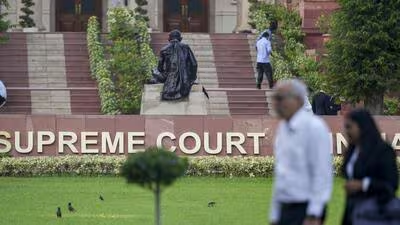
A seven-judge Supreme Court bench on Tuesday disposed of a nearly 22-year-old reference on the constitutional limits of legislative privileges as “infructuous”, after noting that the Tamil Nadu assembly had withdrawn in 2004 the resolution that triggered the proceedings, leaving unanswered for now the larger questions concerning the interplay between legislative privilege and citizens’ fundamental right to freedom of speech and expression.
We are in full agreement with the suggestions given by the petitioners. The present writ petitions are thus disposed of as being infructuous. “However, counsel for the petitioners refer to the December 2004 reference order pointing out that there are various important questions of law that can be kept open for examination in future.
However, questions of law are kept open to be adjudicated in appropriate proceedings in future,” the court said in its order.
The order closes the proceedings without ruling on the substantive constitutional questions referred to the larger bench nearly two decades ago. Senior advocate Ramachandran drew the bench’s attention to the affidavit at the outset of Tuesday’s proceedings. The court observed that if the relevant issues had not been framed, it could leave all the larger questions open. Senior advocates Kapil Sibal, Abhishek Manu Singhvi, Ramachandran, Amit Anand Tiwari and Gopal Sankaranarayanan appeared for the petitioners in the matter. The Supreme Court stayed the execution of the warrants issued against them.
At Tuesday’s hearing, the bench acknowledged that the crucial development that had rendered the controversy academic — the Tamil Nadu Assembly’s unanimous withdrawal of its November 2003 resolution– had apparently escaped the court’s attention when the matter was referred to the seven-judge bench. The order noted that the assembly secretary’s affidavit, filed before the Supreme Court in August 2004, had detailed a resolution passed on July 13, 2004, withdrawing the earlier resolution. The reference arose from the Tamil Nadu Assembly’s action in 2003 against journalists of The Hindu over reports and an editorial critical of the then state government and chief minister J Jayalalithaa. The Assembly sentenced then editor N Ravi, executive editor Malini Parthasarathy, bureau chief V Jayant, special correspondent Radha Venkatesan and publisher S Rangarajan to 15 days’ simple imprisonment for breach of privilege. The dispute was initially referred to a constitution bench in December 2003.
However, this subsequent development “skipped the notice of this court” when it passed an order in December 2004 referring questions arising from conflicting decisions of the court to the present bench.
A five-judge bench subsequently recommended consideration by a larger bench after earlier constitution bench decisions appeared to present conflicting positions on the scope of legislative privilege. On Monday, CJI Kant indicated that the court could dispose of the matter after a brief hearing , leaving the larger issues for another occasion when they arose in a live dispute.
