
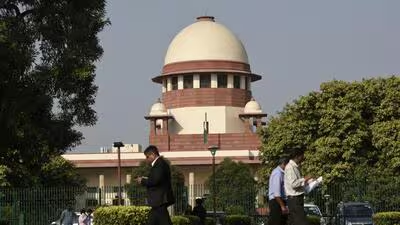
The Supreme Court on Monday indicated that it may not, for now, examine the larger constitutional questions surrounding the limits of legislative privileges and their interplay with citizens’ fundamental right to freedom of speech and expression under Article 19(1)(a), after being informed that the Tamil Nadu assembly resolution that triggered the long-pending reference was withdrawn in 2004.
The Chief Justice then suggested that if the dispute had indeed become academic, the court could defer examination of the larger constitutional questions until an occasion arose in a live matter. The development potentially puts on hold a much-anticipated examination by the seven-judge bench of the constitutional boundaries of legislative privilege, including the circumstances in which state legislatures can invoke their privileges against persons outside the House and the extent to which such powers can operate when they collide with the fundamental right to free speech. The Supreme Court stayed the execution of the warrants issued against them. The case eventually assumed a much wider constitutional significance.
The seven-judge bench had been constituted in the long-running matter of N Ravi and others Vs Speaker, Legislative Assembly, Chennai and others, arising from the assembly’s action against journalists of The Hindu in 2003. The assembly had sentenced then The Hindu editor N Ravi, executive editor Malini Parthasarathy, bureau chief V Jayant, special correspondent Radha Venkatesan and publisher S Rangarajan to 15 days’ simple imprisonment for breach of privilege over reports and an editorial critical of the then Tamil Nadu government and chief minister J Jayalalithaa. The Supreme Court was called upon to examine the relationship between legislative privileges under Articles 105 and 194 and the fundamental freedoms guaranteed under the Constitution, particularly Article 19(1)(a). The issue was initially referred to a Constitution Bench in December 2003. In 2004, a five-judge bench recommended that the questions be considered by a larger seven-judge bench after earlier constitution bench decisions threw up conflicting positions.
Chief Justice of India (CJI) Surya Kant said that the seven-judge constitution bench could instead dispose of the matter after a brief hearing on Tuesday, while leaving the larger questions open for adjudication in an appropriate case when a live controversy comes before the court.
