
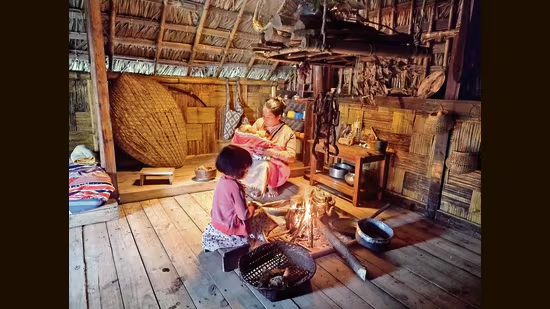
In Kongthong, a person can be summoned without anyone saying their name.
Team Analysis
A melody rises from somewhere on the hillside. It may be sung or whistled. The person it is meant for hears it, recognises it and answers.
For generations, the people of Kongthong village in Meghalaya’s East Khasi Hills have used melodies as names. It is the mother who composes the tune for each baby, soon after its birth. The melody emerges from the intimacy of caring for the infant, and from the love, relief and happiness of having brought a child into the world, villagers say.
The term for these tunes is Jingrwai Iawbei, or Song-Name for the Ancestress.
The tradition is rooted in the tribe’s matrilineal structure. “Iawbei” is “ancestral mother of the clan”. The song-name thus connects each individual with their wider maternal lineage.
“The melodies are not written down. There is no notation, formal musical training or song-naming ceremony involved,” says Rothell Khongsit, a native of Kongthong and chairman of the Meghalaya Rural Tourism Cooperative Federation. “After recovering from childbirth, a mother may begin to shape the tune while holding, walking with or soothing her baby.”
The tune can evolve with the child. A shorter version can be used when they are nearby. The full melody can carry across hills and fields. In a landscape where people may be separated by ridges and forests, the tune becomes a practical form of communication.
Only the person may answer, Khongsit says. “If a man is being called, his wife cannot respond in his place.”
There are a number of origin stories for the tradition, adds National Award-winning Manipuri filmmaker Oinam Doren, whose critically acclaimed documentary on this and other practices in the village is titled My Name is Eeooow (2016). “One version speaks of a man fleeing attackers, climbing a tree, and using his tune to call to people in the village.”
For centuries, if not millennia, this has been the village’s way. It was only when outsiders began to notice the melodies that Kongthong started to see itself through a different lens.
Social media has carried the village’s melodies far beyond Meghalaya. Tourists now travel here to hear the song-names. The village, which had no tourist establishments in 2016, now has seven traditional bamboo cottages run by the village cooperative, one homestay, and a private resort under construction.
The village is working to ensure that the attention benefits but does not overrun them, Khongsit says. He is among those collaborating with the village’s Indigenous Agro Tourism Cooperative Society to build a model in which tourism can create opportunities for villagers, while protecting the culture and landscape.
They arrange Jingrwai Iawbei whistling-tune demonstrations, sell local produce such as honey and fruit, and help train young people for jobs in hotels and as tourist guides.
TUNE BACK TIME
Perhaps the changes will keep the children from leaving, villagers say.
Currently, many are going where their songs can no longer reach them.
They typically leave as schoolchildren, since there is still no higher secondary school in or near the village. Many then enrol for further study at institutes in distant cities.
They return changed, Khongsit says, having adapted to another environment and become less connected to the customs of home, including their song-names.
A high school would help, he adds. Even a few more years spent among the songs in the hills may help them hold on to the notes when they leave.
Leaving isn’t easy either, says Shildamon Pohnong, 30. She works in a hotel in the state’s capital of Shillong and is closer to home now than she has been in recent years; previous jobs took her to Mumbai and Bengaluru. Her song-name has gone everywhere with her, she says.
“Wherever I go, people get to know about our tradition and ask me about it,” Pohnong says. “Some people from our village feel shy, but I sing out my name for them whenever I get the chance.”
