
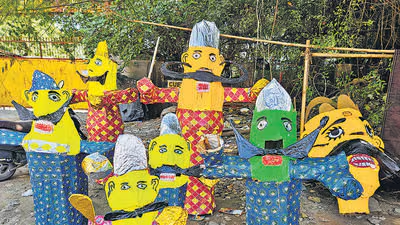
For my debut assignment as a reporter in Gurugram, I was tasked with covering the city’s cultural landscape. With Dussehra just around the corner, I found myself drawn to the makeshift workshops where the city’s effigy makers were breathing life into Ravana.
Their painted eyes stared upwards, while bamboo frames gradually took shape under the hands of skilled craftsmen. Stories about culture offer much more than news; they present a glimpse into how the city was shaped by the tiny corners and pockets that existed long before tower cranes, bulldozers, and road rollers came to define its landscape. Writing about the Ravana effigy-makers of Gurugram was no different. Behind the towering figures were families working for days, sometimes weeks, carefully shaping bamboo structures, cutting paper and cardboard, painting elaborate faces, and assembling arms, legs and crowns. Every detail mattered — the contours of the face, the sharpness of the moustache, the evil in Ravana’s laugh, the choice of colours, and the proportions that would make Ravana look imposing against the festive sky. As I walked past scores of effigy-makers who bring the grand spectacle of Dussehra to life, I met people who found seasonal employment in the craft, and others who, while spending the festive season far from their families, found a way to participate in the celebrations. I remember meeting acab driver, Sonu, who decided to assist an effigy-maker this year and take a break from his usual routine. He had to stay in Gurugram during the festive season to earn a livelihood. He had just finished making his first effigy.
Along a roadside in Sector 15, brightly colored effigy faces lay scattered on the ground.
From the tallest effigies to the smallest, every creation told a story of patience, precision and painstaking craftsmanship. Sonui told me that making effigies brought him a little closer to the festivities, even as he stayed away from his family. “I might earn a buck or two extra here,” he said.
And then there are those for whom the craft is a lucrative trade. Vinod’s great-grandfather also made Ravana effigies, and for his family, the work has since become an annual ritual that brings in good business for a month. One stuck paper to the effigy’s legs, another pieced together bamboo sticks to form an arm, while the son, the designated artist, painted the eyes and those fearsome teeth. In a scattered market where internet trends decide what sells, Gurugram’s effigy-makers, sitting in the sweltering sun, try to keep up with changing tastes and ambitions. Every choice, from the paper they use to the colours they paint with, has to balance what looks good, what fits the pocket, and what might catch someone’s eye on the internet. (Vidhi Bhutra is a correspondent with HT Gurugram covering education, traffic, transport, RWA, culture, and sports)
Today Vinod’s two daughters, son, and wife help him in the craft.
