
Parliament passed the Public Examinations (Prevention of Unfair Means) Amendment Bill, 2026 — which was brought in by the government following massive student protests against irregularities in competitive examinations — with the Rajya Sabha clearing the bill through a voice vote on Thursday, a day after it was cleared by the Lok Sabha.
Event Context
Opposition parties led by Congress staged a walkout in the Rajya Sabha ahead of the passage of the bill, prompting Leader of the House JP Nadda to condemn the move.
Union minister Jitendra Singh, who moved the bill – which overhauls the original 2024 legislation by introducing stricter jail terms, enhancing penalties, and setting specific timelines for probe and trial in fast-track courts — said: “The government remains open to constructive suggestions and has brought forward the amendments after taking recent experience and feedback into account, with the objective of making the law more stringent and effective. The objective of the legislation is to ensure greater consistency, credibility and transparency in public examinations so that sincere and deserving candidates are rewarded for their genuine efforts and their future is not jeopardised by organised examination-related crimes.”
Leader of the Opposition Mallikarjun Kharge welcomed the bill but said it is incomplete in its current form. “After a paper leak, it is important to ensure stringent punishment, but the bill does not have components to stop the paper leak. You have only altered and changed the numbers but not your intention on how to stop it. You have brought this just to quell the current ongoing protests by students on the streets. This has not been brought to solve the issue of paper leaks,” he said.
Criticising the government for the NEET-UG 2026 paper leak and the use of force during last week’s protests, Kharge demanded a fixed annual examination calendar for students to eliminate date uncertainty. He also sought resignation of Union home minister Amit Shah over the handling of the protests and using pellets, lathi charge the student protesters.
The bill was passed after nearly an eight-hour discussion.
Taking part in the debate, BJP MP Brij Lal, who was also police chief of Uttar Pradesh, explained the legality of use of pellets and the use of force during protests. The Centre has been criticised by students, opposition and security experts on the issue of force, especially pellet guns on protesters during a protest march on July 20. The Supreme Court is hearing a clutch of petitions filed on the issue of police excesses.
“There are reports on who gave the orders. The criminal justice system is very clear. Under the commissionerate system, the police are authorised to make decisions. To restore law and order, police first issue warnings, then use water cannons. It was done here. Then tear gas is fired along with rubber bullets. It is a non-lethal weapon. A lot is being said about pellet guns. I am not saying it was used but let me explain what is. A pellet gun is a 12 bore gun with 6 number ball bearings which causes skin deep injuries ,when fired. As DGP Uttar Pradesh, I had ordered 1000 such guns. It was done to ensure that we don’t have to use rifles, which can be fatal. Pellet guns are non-lethal,” Lal said, while listing out incidents of police firing under the Congress government .
Player Focus
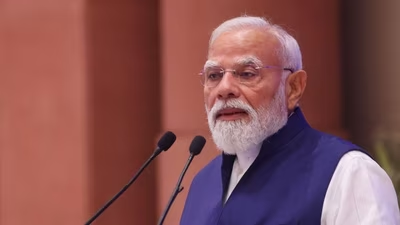
Welcoming the development, Prime Minister Narendra Modi in a video message on Instagram said, as promised, a strong anti-paper leak bill had been passed by both Houses of Parliament as part of the government’s efforts to tackle the menace that has threatened the future of children.
Hailing the development, PM Modi said paper leaks in various examinations have become a major challenge not only for students but also for the Centre and many states. Therefore, it had become necessary to bring comprehensive changes to the education system to deal with the problem, he said.
“The Centre and many states have been facing the paper leak problem for several years,” he said, adding that the government had been continuously working to establish an efficient examination system. “We will not spare the paper leak gangs, paper leak mafia and those playing with the future of children.”
Welcoming the development, home minister Amit Shah said: “The Modi govt today set a significant milestone in securing the future of our students by passing the Public Examinations (Prevention of Unfair Means) Amendment Bill, 2026, in Parliament.”
He added: “The new law will emerge as the strongest deterrent against crimes that threaten the aspirations of our youth by diluting the credibility of our public examination system. By laying down the harshest provisions to punish anyone who attempts to tamper with the fairness of the merit-based framework, the new law will ensure that our youth fulfill the dreams they have envisioned for themselves.”
Match Outlook
Aam Aadmi Party(AAP) MP Sanjay Singh said that when the NEET-UG retest was conducted the number of students was lesser than the ones who had taken the earlier(cancelled) test . “ Nearly 280,000 students could not take the retest? Who is responsible for this? From the contents of this bill, it looks like the government will be unable to prevent the leak in the future. There are stringent jail terms, fines and addition of special courts. But the responsibility of the government is to prevent the leak and conduct a fair exam. The government is not confident of holding a fair examination without any paper leak.”
Replying to the debate, Jitendra Singh said the opposition leaders had not read the bill properly. He said that the bill covers a wide spectrum to prevent leaks at different levels. “Many members talked about abolishing NTA. More leaks happened in states through state service boards and not necessarily through NTA. There were suggestions regarding coaching institute industry and making it more transparent. The committee headed by Mr Nilekani has been specifically constituted to look into all these issues. The issue is vast and serious. It cannot be left to the government alone. We call for cooperation from all sections of society, citizens, families. We are proceeding with an open mind. We are ready not just to walk the talk but ready to walk an extra mile too.”
