
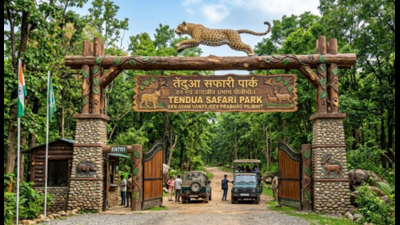
LUCKNOW To address a severe spike in man-animal conflicts and find a permanent rehabilitation solution for rescued leopards, the Uttar Pradesh forest department has planned to establish the state’s first Leopard Safari across the Pilibhit and Shahjahanpur districts.
Once cleared by the Central Zoo Authority (CZA), the project could provide UP with a dedicated mechanism for managing rescued leopards while addressing the growing challenge of human-leopard conflicts. The department plans an entry gate leading to the safari route, a theatre and leopard-proof fencing that will keep leopards and people safe from each other, while visitors watch the animal in its natural habitat. “With an increasing leopard population and conflicts with humans, we have decided to come up with a leopard safari in Pilibhit, which is in the final stages of approval. A leopard safari will serve many purposes: ensuring human safety, providing a natural habitat for leopards, generating revenue and maintaining the wildlife ecosystem.
The proposed facility, located in the Gopalpur forest range, will span 1,974 hectares—944.6 hectares in Pilibhit and 1,030.1 hectares in Shahjahanpur. The project will need a ₹ 49.45 crore grant to put leopards behind the fence. At least half a dozen districts in the state were reporting human-leopard conflicts every week while at least 200 leopards had been rescued in UP since January and released back into the wild. Leopards were rescued in Bahraich over four successive days (September 4 to 7).
Another safari will come up in Gonda district,” said UP forest, environment and climate change minister Arun K Saxena.
Five deaths were reported in instances of human-leopard conflict. *In August, Moradabad reported four deaths in leopard attacks. “The leopard safari proposal has been cleared by the state government. It has been forwarded to the Central Zoo Authority (CZA) in New Delhi. India has four leopard safaris, including the Leopard Sanctuary in Jaipur, Rajasthan; Manikdoh Leopard Rescue Centre in Junnar, Maharashtra; South Khairbari Leopard Rescue Centre in West Bengal and Vantara in Jamnagar, Gujarat. Learning and knowledge sharing from these safaris will be done before implementing UP’s project on the ground. Apart from fencing, the forest department will also introduce stem and tree cover to prevent leopards from crossing the fence from a height. Almost the entire forest area will be conserved.
Uttar Pradesh reported 371 leopards in 2022, including 29 in Pilibhit, 125 at the Dudhwa National Park, Lakhimpur Kheri and 67 in the Ranipur Tiger Reserve. INCREASING LEOPARD ATTACKS *Lakhimpur Kheri reported eight deaths in human-leopard conflicts since January 2026. The victims included five minors. *In Bahraich,18 leopards were rescued in Katarniya forest range, including 13 since July 21. Bijnor also witnessed at least four fatal leopard attacks. *Since 2023, Bijnor has reported at least 37 deaths from human-leopard conflict, making it one of the major conflict hot spots in the state. The district also recorded at least 120 leopard rescues since 2023. Across UP, the number of leopards rescued during the period was estimated to be no less than 400.
Clearance from the CZA is mandatory for developing the safari and keeping leopards under the prescribed protocol,” said Anuradha Vemuri, principal chief conservator of forests (wildlife), Uttar Pradesh. “The forest department has also conducted a survey to record animals seen directly, animal tracks and signs, dung/pellets, nests, burrows or dens, vegetation and habitat characteristics,” said PP Singh, chief conservator of forests, Rohilkhand zone. “The exact number is not known as the census was done for the landscape but at least 1500 leopards must be present in the state,” a senior forest official said.
