
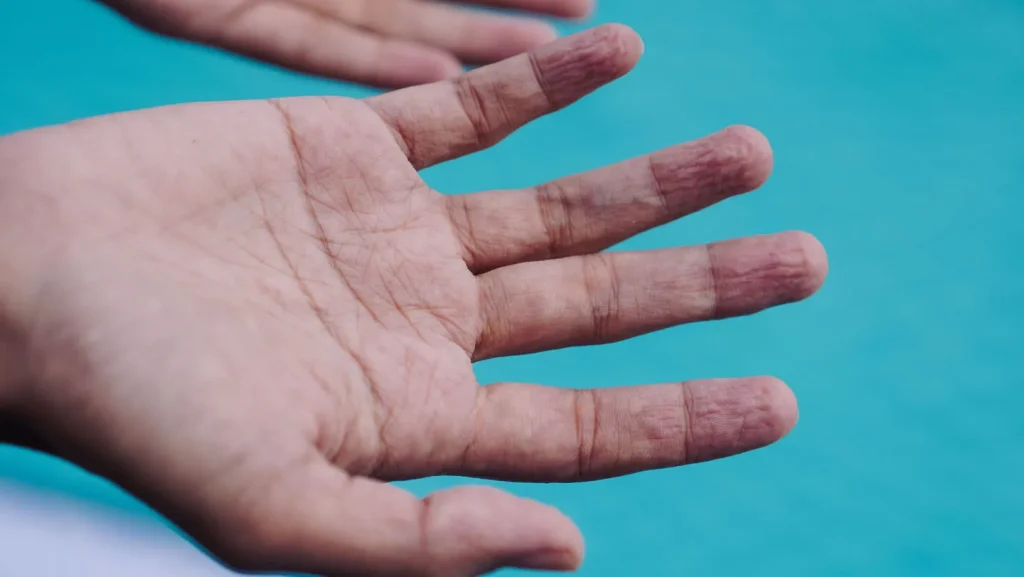
In today’s episode of Everyday Explained, we’re looking at something you’ve probably noticed after spending too long in the bath, swimming pool or shower: your fingers suddenly look like tiny prunes. But why does this happen? And is your skin actually absorbing water and swelling up? The answer is more surprising than you might think. (Also read: Everyday explained: Why are school buses always painted yellow? )
Why do your fingers wrinkle but not your whole hand?
For years, the common explanation was that the outer layer of the skin absorbs water and swells, causing it to wrinkle. But research has shown that water-induced finger wrinkling is actually an active process controlled by the autonomic nervous system. A study published in Muscle & Nerve found that the wrinkling is linked to vasoconstriction, or the narrowing of blood vessels in the fingers. When your fingers are submerged in water for a while, blood flow to the fingertips decreases. As the blood vessels constrict, the tissue beneath the skin loses some volume, causing the skin above it to fold and form wrinkles. The process is controlled by the sympathetic nervous system, which is part of the autonomic nervous system and regulates functions that happen automatically. Research has found that finger wrinkling after water immersion depends on intact sympathetic nerve pathways. This is also why the wrinkles disappear once you dry your hands. As blood flow returns to normal, the tissue regains its volume and the skin gradually smooths out. Scientists have also explored whether water-induced wrinkles serve a practical purpose. The researchers suggested that the wrinkles may have evolved to improve handling of objects in wet conditions. More recent research has also found that wrinkled fingers may reduce the amount of grip force needed to hold wet objects, suggesting that the wrinkles could improve grip efficiency in watery environments. However, the theory is not universally accepted. So, while the grip theory remains an interesting explanation for why this response may have evolved, scientists are still studying its exact function. The wrinkling is most noticeable on the fingertips and palms, areas known as glabrous skin, which do not have hair. These areas have a distinctive structure and rich supply of nerves and blood vessels. Interestingly, water-induced finger wrinkling has also been studied as a simple indicator of sympathetic nerve function. Your nervous system is actively changing blood flow to your fingertips and those tiny wrinkles may have a functional purpose too.
A 2013 study published in Biology Letters found that people could handle submerged objects more quickly with wrinkled fingers than with unwrinkled fingers. A separate 2014 study found that wrinkling did not improve dexterity when handling wet objects and did not affect touch sensitivity. Because your skin has soaked up water, so, the next time your fingers turn wrinkly after a long bath, remember: it isn’t simply.
