
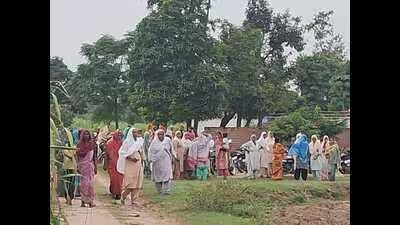
Two children killed in leopard attacks within three days have renewed fear in villages along the Dudhwa Tiger Reserve buffer zone, where nine people, including six minors, have died in such attacks between April 2026 and October 14, according to forest officials. The back-to-back deaths have exposed the difficulties of preventing attacks in a landscape dominated by dense sugarcane fields, scattered settlements and an understaffed forest force.
Seven-year-old Saniya was killed on October 12 after a leopard dragged her from outside her house in Bojhiya village under the Dhaurahra forest range. On the night of October 14, six-year-old Navjot was reportedly picked up by a leopard from the courtyard of his house and killed, triggering fresh anger among residents. Her mutilated body was found in a sugarcane field the following morning. The department has set weekly targets for field staff to visit two to three villages in each range or section, meet residents and explain safety precautions. The recent attacks, he added, showed that awareness efforts needed to be intensified. Staff stretched across multiple emergencies The workload on the forest department is evident in the frequency of calls from conflict-prone areas. Some ranges receive two or three incident reports in a single day, forcing teams to move between locations and leaving less time for sustained preventive work. The pressure on frontline teams comes as public anger grows over the department’s ability to protect communities living alongside wildlife. With fewer than the sanctioned number of guards available, responding to an incident can also mean diverting personnel from other vulnerable locations. Altering crop patterns near reserve forests, particularly reducing the extensive cultivation of sugarcane that provides cover to big cats, is one of the long-term approaches that could encourage them to remain inside forest areas. Fencing has already been undertaken in some sensitive locations, including Majhra, to help counter human-animal conflict. Sterilisation, meanwhile, is a possible long-term population-management measure, not a current Dudhwa proposal. He cited it as an option that could be considered over the longer term in Dudhwa, while cautioning that any results would take years to emerge.
Rajamohan, however, said the impact of awareness drives often faded as people returned to their normal routines and lowered their guard. Nighasan buffer zone sub-divisional officer Manoj Tiwari said families had repeatedly been advised not to allow children to move around alone, particularly after dark. Rajamohan said staff had to respond to elephant movements at night, tiger and leopard incidents during the day, and occasional reptile-related cases. rescue and monitoring operations are handled largely by the department’s own staff, Tiwari said While WWF personnel assist with awareness campaigns in selected villages. Crop patterns central to long-term strategy Rajamohan said lasting relief would require more than capturing leopards after an incident. Rajamohan said the approach had been proposed in Maharashtra and in leopard-hit Bijnor district, but its implementation and results were not yet known to him.
The overall figure may also include captures from Katarniaghat, and its geographical coverage needs confirmation. Officials remain uncertain about how many leopards continue to move through the extensive sugarcane fields. The dense cover makes it difficult to locate a leopard or anticipate where it might strike next.
Despite the constraints, Rajamohan said 22 leopards had been captured during the current financial year, including 18 from the Nighasan area.
“The problem is that vast stretches of sugarcane fields dominate areas close to the reserve forests, providing safe shelter and corridors for big cats, while human settlements in between compound the situation,” Rajamohan said.
The attacks have renewed questions about a response largely centred on tracking, capturing and relocating leopards, along with public awareness campaigns. Officials acknowledge that these measures are difficult to sustain across multiple conflict-prone locations, particularly when sugarcane fields provide big cats with cover close to human settlements. Dudhwa Tiger Reserve field director Dr H. The shortage of personnel adds to the challenge.
27 forest guards were posted against a sanctioned strength of 52 as of June 2026, leaving nearly half the posts vacant, according to Dudhwa buffer zone deputy director Kirti Chaudhary.
Rajamohan said the department was grappling with overlapping wildlife emergencies: Tiger and leopard movements during the day, elephant movements at night and occasional crocodile and other reptile-related incidents were placing considerable pressure on frontline teams.
