
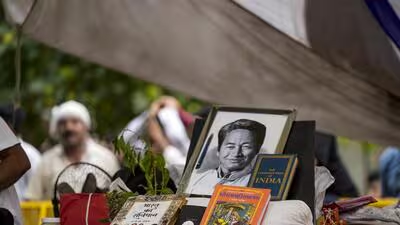
Activist Sonam Wangchuk, whose hunger strike and forcible removal from Delhi’s Jantar Mantar galvanised the Cockroach Janta Party (CJP) protest movement against paper leaks and exam irregularities, is keen on a dialogue with the government, and the two sides are set to talk, people aware of the matter said on Wednesday. The people said Union ministers JP Nadda and Jitender Singh met Wangchuk on Tuesday night.
Latest Update
The CJP garnered millions of followers on social media before launching a sit-in protest on June 6 demanding Pradhan’s resignation. Crowds swelled through the weekend, and by Monday morning, students and young professionals defied heavy barricading to join the protest.
The protest continued for about three-and-a-half hours before the protesting leaders were forcibly dragged away and bundled into buses. Gandhi was taken to Chhatrasal Stadium in North Delhi and released around 10pm. Priyanka Gandhi Vadra was sent to Mandir Marg police station in central Delhi, prompting former Congress chief Sonia Gandhi to rush there. She was released at 9.45pm.
At Jantar Mantar, the CJP and student protesters regrouped, demanding Pradhan’s resignation as hundreds of people poured into the site.
Details
“The government is open to talks. We have been constantly saying so… they did not come to us earlier. Now that we have been told that he [Wangchuk] wants to communicate, we will talk,” said a government functionary.
CJP chief spokesperson Saurav Das maintained that the government reached out to Wangchuk for talks and it was not the other way around.
HT has reached out to educator Gitanjali Angmo, Wangchuk’s wife, and the activist for comments. There was no immediate response.
The functionary cited above referred to Nadda’s meeting with the CJP representatives on Monday and said they met when they were reached out to. Nadda said the CJP approached them to present their demands.
Wangchuk was discharged from Delhi’s Safdarjung Hospital on Tuesday and shifted to Medanta Hospital in Gurugram. The shifting followed a Delhi high court order. Wangchuk moved the court to be shifted to a hospital of his choice, citing his fundamental rights under the Constitution’s Articles 19 and 21.
Two days after Wangchuk was removed, tens of thousands of agitators marched to Parliament on Monday demanding Union education minister Dharmendra Pradhan’s resignation over repeated paper leaks, making it the largest public protest in Prime Minister Modi’s third term.
The protesters braved police batons and barricades. They toppled barricades and moved closer, prompting the sealing of the gates of the Parliament complex for the first time since the 2001 attack. Commandos took up positions with automatic weapons.
The CJP called for the march to Parliament after a 23-day-old sit-in hunger strike at Jantar Mantar. It was formed after Chief Justice of India (CJI) Surya Kant’s remarks referring to some people as “cockroaches” and “parasites. The CJI maintained that his remarks were not directed at the youth but at individuals who entered professions such as law and media using “fake and bogus degrees”.
The Delhi Police said the planned but unauthorised march was handled “professionally,” but visuals showed security personnel in full riot gear thrashing young unarmed protesters. Officials admitted they had underestimated the strength of the gathering.
On Tuesday, Congress leader Rahul Gandhi led an unprecedented protest outside Prime Minister Modi’s residence, even as Opposition leaders visited Jantar Mantar to back agitating students. Two chief ministers and allies, including Samajwadi Party chief Akhilesh Yadav and Nationalist Congress Party – Sharadchandra Pawar leader Supriya Sule, were among those who joined the protest outside Modi’s residence.
