

On September 11, 2001, in one of the deadliest terrorist attacks in history, terrorists crashed two hijacked commercial airliners into the World Trade Center in New York , bringing down the twin 110-storey towers in a devastating assault on the United States.
The attacks claimed nearly 3,000 lives and reduced New York’s landmark Twin Towers to rubble. Twenty-five years after the attacks, the memorial at Ground Zero continues to draw visitors from around the world, who pause to read the nearly 3,000 names engraved on the parapets surrounding two reflecting pools. The coordinated attacks also included the crash of American Airlines Flight 77 into the Pentagon in Washington, D.C. Another hijacked aircraft, United Airlines Flight 93, crashed in rural Pennsylvania after passengers attempted to overpower the hijackers and regain control of the plane. On the 10th anniversary of the attacks on September 11, 2011, the Memorial pools and plaza were dedicated to the victims’ families by the then U.S. 911 memorial Designed by Michael Arad and Peter Walker, the memorial, known as Reflecting Absence, comprises two enormous pools located on the footprints of the former Twin Towers . 9/11 Memorial Museum, New York The Memorial Glade features six stone monoliths inlaid with steel salvaged from the World Trade Center. Built over the footprints of the destroyed buildings, the museum begins at street level before descending nearly 70 feet to the foundations of the towers, which remain visible. The National September 11 Memorial Museum, designed by Davis Brody Bond and Snøhetta, opened in 2014. Located between the two reflecting pools, the museum encompasses about 110,000 square feet of underground exhibition space, with only the entrance pavilion and plaza visible above ground. A sign tracking the time Osama Bin Laden was at large displayed at the National September 11 Memorial Museum. | Photo Credit: AP The museum is broadly divided into three sections. The first explores life before September 11, tracing the construction of the Twin Towers and their significance as symbols of American ambition and economic power. The second section focuses on September 11, 2001, documenting the attacks on the World Trade Center and the Pentagon, the hijacked aircraft and reactions from around the world. The museum also houses the nearly 36-foot Last Column, covered with memorial inscriptions, mementoes and missing-person notices. The constant flow of water serves as a reminder of the events of September 11 and the lives lost that day. The structure stands 1,776 feet tall, a symbolic reference to the year of American independence, and represents the regeneration of the World Trade Center site. Reflecting pools at the 9/11 Twin Towers memorial. | Photo Credit: AP On a section of the outer link fence, a photo exhibition traces the timeline of the attacks through photographs and artefacts.
The In Memoriam exhibition honours those who lost their lives. The collapse of the towers left a void in both the city and the national psyche. The Memorial, Museum and Memorial Glade that now occupy the site stand as symbols of remembrance and resilience. An international design competition was held to select the architect for the Ground Zero memorial. Built in phases, the memorial complex took several years to complete. President Barack Obama. Each pool spans about an acre and features waterfalls cascading into a central void, creating a powerful reminder of loss and remembrance. Set along a tree-lined pathway, the installation honours recovery workers and others affected by the aftermath of the attacks. Clad in glass and steel, the pavilion reflects the changing cityscape, trees and sky. It also examines the planning and execution of the attacks. The third section pays tribute to the resilience of those affected by the tragedy, highlighting rescue and recovery efforts, community support and the rebuilding of Lower Manhattan. The journey through the museum begins in a dimly lit hall, where visitors hear recordings from survivors, witnesses and victims. A staircase descends to the main galleries, including the History Gallery, In Memoriam and the Foundation Hall. A long curving walkway leads to the Foundation Hall, where twisted steel beams and other remnants of the towers are displayed. Among the most poignant exhibits is the surviving stairway that connected Austin J. Tobin Plaza to Vesey Street, which provided an escape route for many people following the attacks. One side of the Foundation Hall features the Slurry Wall, constructed to prevent water from the Hudson River from entering the site during excavation of the Twin Towers. The structure survived the attacks and helped avert further damage by preventing flooding in the surrounding transit network. It remains one of the most significant surviving elements of the original World Trade Center complex. Above it stands an eight-acre plaza planted with hundreds of white oak trees, creating a tranquil public space dedicated to reflection and remembrance. Among the museum’s most moving installations is the wall of photographs depicting nearly all of the victims who died in the attacks. Audio recordings from family members offer personal tributes to their loved ones. Family members can access a private space behind the repository wall to pay their respects. Outside, the two reflecting pools form the centrepiece of the memorial. The names of the victims are inscribed on bronze parapets surrounding the pools. The names of the victims are inscribed on bronze parapets in the Twin Towers memorial. One World Trade Center, popularly known as the Freedom Tower, rises beside the memorial complex. Apart from the Twin Towers’ memorial complex, memorials were also set up at Pentagon and Pennsylvania.
A repository bearing a quotation from Virgil, “No day shall erase you from the memory of time”, holds thousands of unidentified human remains recovered from the site.
Images range from everyday scenes before the attacks to the devastation that followed, capturing both the human and historical dimensions of the tragedy.


Each memorial unit records the victim’s age and location at the time of the attack. Pentagon memorial Designed as cantilevered benches with illuminated pools of water, each memorial unit is constructed from stainless steel and granite. The flowing water reflects light across the memorial during the evening. Pentagon Memorial near Washington. Family members who died together are linked through plaques bearing their names.
The Pentagon Memorial honours the 184 people killed in the attack on the Pentagon. The memorial comprises 184 benches, one for each victim. The orientation of each bench distinguishes victims who were inside the Pentagon from those aboard Flight 77. Memorial units honouring Pentagon victims face the building, while those commemorating passengers and crew aboard Flight 77 face the aircraft’s approach path. In Pennsylvania, the Flight 93 National Memorial near Shanksville commemorates the passengers and crew who lost their lives after resisting the hijackers. Forty luminaria are placed at the wall of names in memory of the 40 passengers and crew of United Flight 93 at the Flight 93 National Memorial The memorial includes the Memorial Plaza and Wall of Names, which opened to the public on September 10, 2011. The Visitor Centre Complex was completed in 2015, while the Tower of Voices was dedicated on September 10, 2020. Flight 93 National Memorial
The benches are arranged according to the victims’ years of birth, creating a chronological landscape of remembrance.


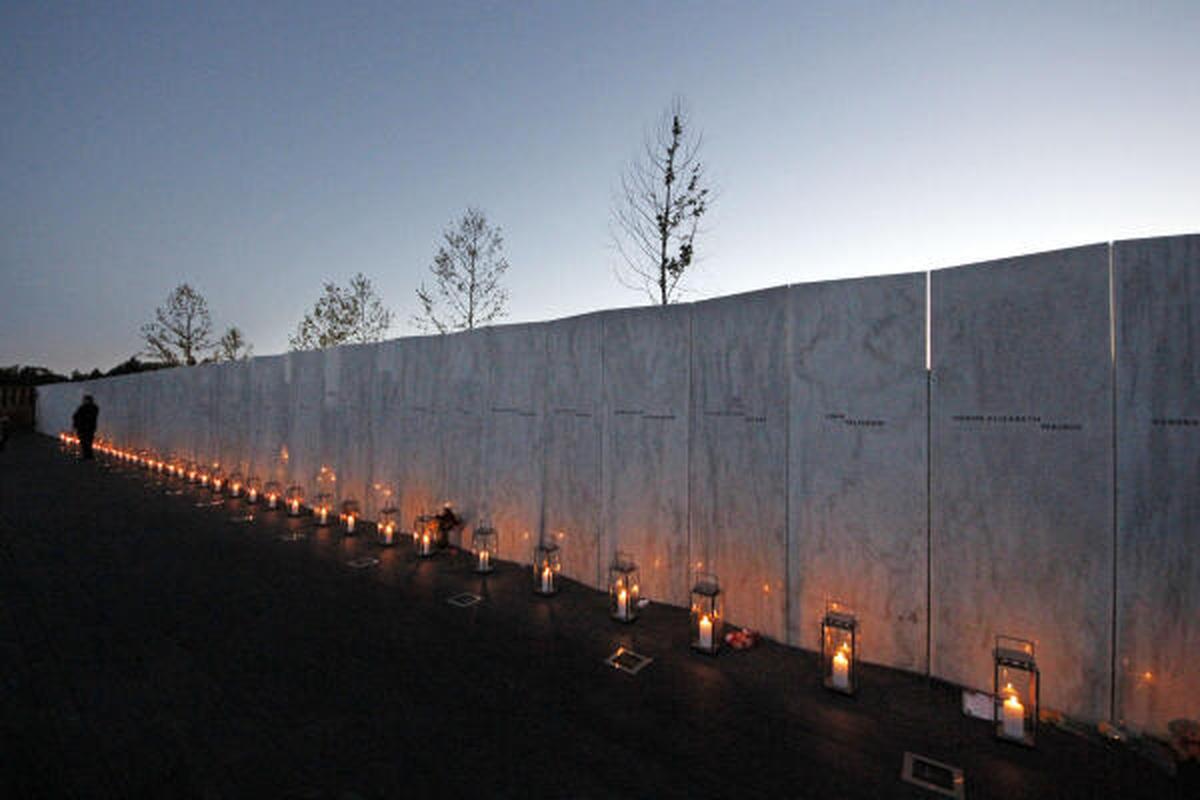

The Wall of Names stands along the continuation of Flight 93’s flight path. The Tower of Voices, a 93-foot-tall musical monument, contains 40 wind chimes representing the passengers and crew of Flight 93. The crash site and debris field form the focal point of the memorial. A sandstone boulder marks the approximate impact site beside a grove of hemlock trees. Forty polished marble panels bear the names of each passenger and crew member. A black granite walkway leads visitors through the Visitor Centre and towards the Flight Path Overlook, offering views of the crash site, the hemlock grove and the Wall of Names. Activated by the wind, the chimes serve as a lasting tribute and a prominent landmark at the memorial entrance.
