
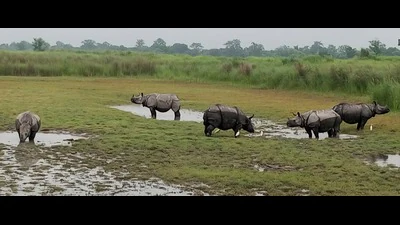
Once extinct in Terai forests due to hunting and some other factors in the pre-independence era, the mighty one-horned rhinos have made an impressive comeback to their ancestral home to the forests of Dudhwa, courtesy the rhino rehabilitation programme introduced in 1984.
The number would have been much more if some rhinos had not fallen prey to tiger attacks or mating conflicts. DEV KANT PANDEY With adaptable habitat conditions and best conservation efforts by Dudhwa Tiger Reserve (DTR) authorities, their population has now grown to 53 from the initial five animals brought from the forests of Assam. Today, there are 17 male, 25 female and 11 sub-adults, as per latest annual head-count in June 2026, marking a significant milestone in Dudhwa’s rhino conservation.
Field director, DTR, Dr H Rajamohan said that the adaptable environment of Dudhwa helped the one-horned rhinos flourish on their ancestral land. He said, “to improve the gene-pool among Dudhwa rhinos, we have been gradually freeing them from solar-powered enclosures and releasing them into the forest for free movement.
The rhino reintroduction programme in Dudhwa started in April 1984, when five rhinos — three females, Pavitri, Saheli and Asha, and two males, Bankey and Raju — were brought from the forests of Assam. These rhinos were kept inside a 27-square-kilometre solar-fenced enclosure in the Kakaraha forest in Sonaripur range of Dudhwa. Four female rhinos brought from neighbouring Nepal in 1985— Narayani, Rapti, Himrani and Swayamvara — strengthened the breeding population at Dudhwa. The next phase of the programme took shape in 2018 when the need for a second rhino rehabilitation area (RRA-2) in a 14-sq km area with identical habitat conditions of RRA-1 in Belrayan range was felt to accommodate the growing rhino population in RRA-1. The initiative also aimed at addressing the concerns associated with inbreeding, including the risk of genetic defects as well as territorial and mating-related conflicts among the rhinos in RRA-1. Over the past eight years, the group of four rhinos in RRA-2 has also grown from four to six so far.
So far, eight rhinos have been freed from their electrified enclosures in different phases while some more are awaited to be released into open forests of Dudhwa within next few months, DTR officials informed. Moreover, DTR authorities have prepared detailed profiling of each rhino in Dudhwa: those inside their enclosure and those released into the open, recording every aspect of their physique, health characteristics, nature etc so as to improve their conservation. The DTR administration is now preparing to take the next step in its conservation journey that is gradually releasing Dudhwa rhinos from solar-powered enclosures to allow them to roam freely in the forest. The step served two purposes, one to accommodate the growing population and the other – major one – to ensure gene diversity among them. Furthermore, DTR authorities have ensured radio-collaring of the rhinos, to ensure round-the-clock monitoring of their movements by a dedicated team. Dudhwa’s rich habitat with vast grasslands, wetlands and woodlands helped sustain the rhino population.
