
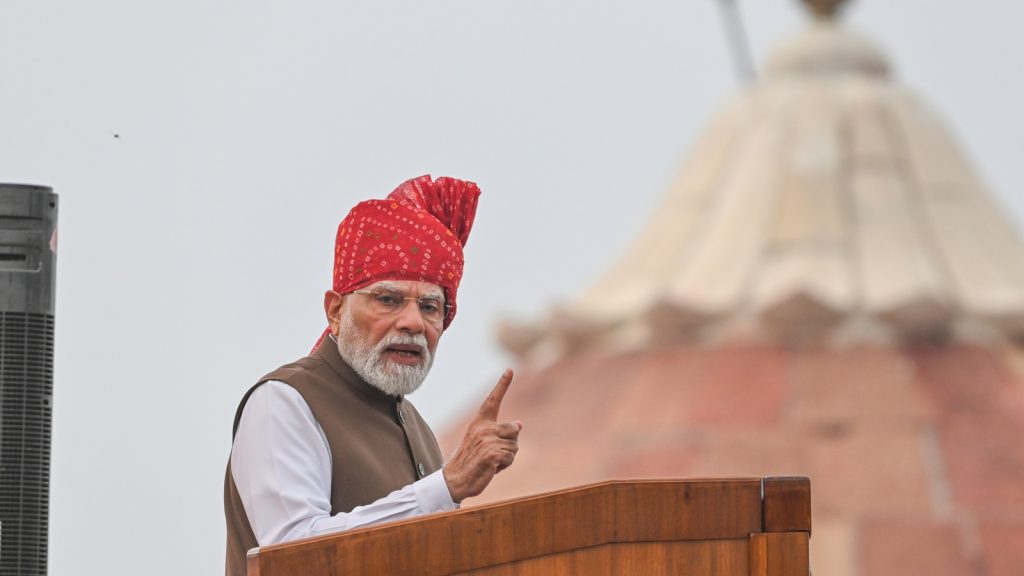
This was Prime Minister Narendra Modi’s 13th address from the ramparts of the Red Fort. The previous twelve were built largely for a domestic audience. This one was not. It was a global speech — and that distinction matters.
Three words anchored the address: self-esteem, self-confidence, self-reliance. Around them, the Prime Minister built a case for three assets — semiconductors, critical minerals and energy. On semiconductors, he spoke of scaling from three plants to eight. On energy, he split the pitch into nuclear power and exploration — moving India from ‘no-go’ to ‘all-go’ zones, unlocking roughly a million square kilometres in the Bay of Bengal of offshore area that had been stuck for years on defence and environmental clearances. The framing was also civilizational: at a time Pakistan is staking claim to the Indus Valley legacy, PM Modi invoked the ‘Sapt Sindhu’ — a deliberate, pointed counter. For years, big global energy and defence players have had little incentive to see India explore its own reserves or build its own weapons — a captive buyer suits them better. That is the deficit Modi is trying to close. His message was blunt: India is no longer only the market; it intends to be the supplier.
But that shift needs reform on the ground — cutting not just the ease of doing business, but its cost, where bureaucrats answerable once every 35 years often move more slowly than politicians who face voters every 5 years. On minerals, of joint ventures to secure supply chains India doesn’t control today.
Foreign Policy: Answering The Critics
The opposition used the Monsoon Session to target Modi’s foreign policy — the optics of hugging world leaders, and strained ties with neighbours like Bangladesh. The record tells a different story. Reliance’s tie-up with Rolls-Royce and GTRE’s with France’s Safran, both pending Cabinet Committee on Security clearance, highlight a real dependency risk: Rolls-Royce’s deep US component ties mean Washington retains leverage. A private-sector engine is welcome, but India still needs a sovereign one — which is where the Safran partnership, and the indigenous Kaveri programme, matter. The opposition seized on Modi’s phrase referencing what he called ‘dimagi Naxals’. He was not labelling the opposition; he was targeting a specific strain of Maoist-Leninist ideology embedded across media, academia and government — people who find something to oppose in India regardless of the facts. The politics around it will continue. But until the opposition offers a competing vision rather than commentary, that criticism will struggle to land beyond social media.
India’s revival of Gulf ties, with the UAE now among its closest partners, marks a sharp turn from the era when an Indian ambassador was denied entry to receive the hijacked IC-814 Middle East. None of this is separate from politics: BJP’s West Bengal win rattled the opposition, and with Uttar Pradesh, Punjab, Himachal and Goa — nearly 150 Lok Sabha seats worth of states — heading to the polls, manufacturing grievance is a strategy, not a critique. France, by contrast, kept supplying navigation systems for India’s Prithvi missiles even after the 1998 nuclear tests made India a pariah.
India today is the first responder in disasters from Nepal to Turkey to the Maldives, and sits at the global table rather than the side one.
