
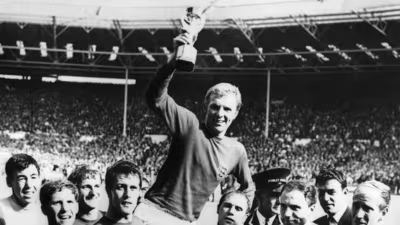
The FIFA World Cup trophy is one of the most recognizable symbols in football, lifted by champions after the sport’s biggest tournament every four years. But before the current golden prize became a global icon, its predecessor had a history involving two thefts, one unlikely recovery and a disappearance that remains a mystery.
Why don’t World Cup winners keep the trophy?
As Spain and Argentina prepare to compete for the 2026 World Cup title, the winning captain will lift the current FIFA World Cup trophy, a design created by Italian sculptor Silvio Gazzaniga in 1971.
The trophy replaced the original Jules Rimet Trophy, which Brazil retained permanently after winning its third World Cup title in 1970.
Here’s the story behind how football’s most coveted prize got its current form.
The first World Cup trophy was introduced for the inaugural tournament in 1930. Known as the Jules Rimet Trophy, it featured a gold-plated sculpture of Nike, the Greek goddess of victory, holding a cup above her head.
The trophy was named after Jules Rimet, the FIFA president who helped establish the World Cup.
However, FIFA needed a replacement after Brazil made history by winning its third World Cup in 1970. At the time, tournament rules allowed the first nation to win three titles to keep the original trophy permanently.
Following Brazil’s victory, FIFA launched a competition for a new design. More than 50 proposals were submitted, but Italian sculptor Silvio Gazzaniga’s design stood out.
Also Read: Argentina President Javier Milei reveals superstition behind not attending World Cup final vs Spain
Gazzaniga created the trophy in his studio in Milan’s Brera neighborhood. His design features two human figures spiraling upwards towards a globe, representing the world.
Gazzaniga’s son, Giorgio, recalled his father’s creative process while designing the iconic prize. “When he started to design the cup, he was sketching a huge number of drawings and finally started to develop the idea to have the world and this symbol that it is like two DNA spirals, that are moving up,” he said, according to The Associated Press (AP).
Yes, the original Jules Rimet Trophy was stolen twice.
The first theft happened in 1966, when the trophy was displayed in England ahead of that year’s World Cup. According to FIFA records, the prize disappeared from an exhibition, sparking a nationwide search.
The trophy was later discovered under a hedge in south London by a dog named Pickles, who became famous for helping recover football’s biggest prize.
The second theft took place in 1983, after Brazil had permanently received the Jules Rimet Trophy. It was stolen from the Brazilian Football Confederation headquarters in Rio de Janeiro.
Unlike the first incident, the trophy was never recovered. It is widely believed to have been melted down after the theft.
Also Read: Spain vs Argentina: Restaurants, bars or theatre, where are you watching the FIFA World Cup 2026 Final?
Despite its immense value and symbolic importance, World Cup winners do not permanently keep the original trophy today.
The official FIFA World Cup trophy is made of 18-carat gold, stands 36 centimeters tall and weighs around 6.175 kilograms. Its base contains two rings of green malachite, symbolizing football fields.
After the tournament celebrations, FIFA takes the original trophy back to its headquarters in Switzerland for safekeeping. The winning team receives a gold-plated replica to keep.
Gazzaniga’s design has been used at 14 World Cups and FIFA has confirmed it will remain the tournament’s official trophy at least until the 2038 edition.
Reflecting on the first time his father’s creation appeared at a World Cup final in 1974, Giorgio Gazzaniga remembered watching West Germany lift the trophy after defeating the Netherlands.
Team Analysis
“The real explosion of joy came when the German team raised the cup in Munich and the whole stadium erupted,” he said. “That was the moment an object became an icon.”
Match Outlook
The sculptor wanted the trophy to capture three emotions linked to football, the effort of the athlete, the celebration of fans and the moment of victory.
