
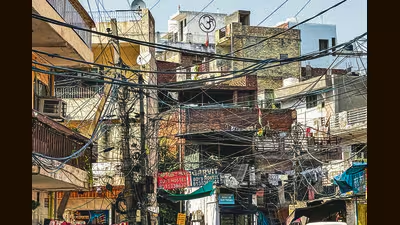
The visibility of a city’s unevenness after Satya Niketan is a pattern we have all seen before.
A tragedy, photo ops for ministers and officials, a reel of someone being scolded, and then the arrival of the “Peela Panja” – the yellow claw, the bulldozer.
Satya Niketan brings to your face a student housing crisis that the city does not acknowledge. No annual record from official sources tracks this population. One has to imagine it instead: from Delhi University to Jawaharlal Nehru University, IIT-Delhi to AIIMS, IGNOU to South Asian University, students arriving from across India and beyond. University housing does not come close to accommodating them. The average student arrives knowing almost nothing about Delhi’s rental market, and is still subjected to its rates, its obscure sub-tenancy arrangements, and its moral policing. These three conditions are not separate problems. They are interdependent. What placemaking has the city and its administration done to accommodate a migration of higher education students that is, by any measure, economically valuable? Delhi’s own state and central universities have not expanded student housing in any comparable way, despite holding the land to do it. Private universities have answered the question in their own way. OP Jindal Global University in Sonipat has treated construction and education as inseparable from the start, an ever-expanding campus built to keep pace with its faculty, its schools, its pedagogy. Delhi’s own planning authority has never run a housing scheme built specifically for students. The city has never treated its student population as a category worth designing for at the level of public space or purpose-built neighbourhood infrastructure, the way a university town elsewhere might zone a student quarter outright. Instead, neighbourhoods like Satya Niketan, Munirka, Mukherjee Nagar, and Kamla Nagar absorbed the demand on their own, dangerously. Delhi is as much a student town as it is a town of judges, politicians, lawyers, and bureaucrats. The vulnerability of its students is the state’s to care for. Instead, it has produced only a faster reflex for the theatre of consequence and no reflex at all for prevention. A suspended officer is not a repaired sewer. A demolished building is not a housed student.
Because most PGs are never licensed or granted building-plan permission to operate as PGs, they function in a grey zone, and that grey zone survives by staying invisible – by keeping the house’s real use hidden from the street so as not to invite official attention. Because visibility, not care, is what this state has learned to produce on demand, the Peela Panja arrives with the cameras already rolling,.
