
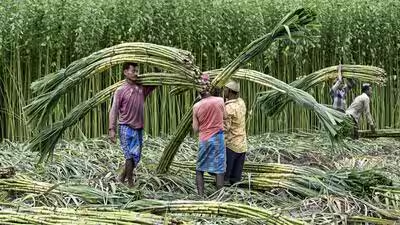
Every year, around July 15th, a heavy mechanical giant will awaken in Mandya taluk, just outside Bengaluru. Heralded by a puja and announced in newspapers, Operation “Sugar-Crushing” will begin. The state-owned Mysore Sugar Company, affectionately called as Mysugar (or Mysugaru in common parlance), will officially commence its sugarcane crushing for the season. This begins with pomp and ceremony. An MLA or minister will ceremonially ignite the factory’s massive boilers, creating a poof of fire. Plumes of smoke will soar to the sky. And then the sugar-crushing season begins. Lines of trucks, tractors, and bullock carts stacked high with green-stalked cane will queue along the roads, waiting patiently for their turn so that their harvest of cane can be crushed into sweet sugar. And thus, over half a million tonnes of sugarcane will be pulverized, boiled and crystallized into the food that Kannadigas call bella and the North Indians call gud.
Event Context
I originally thought that the choice of the date was linked to some auspicious day in the lunar calendar. But it really has to do with some colonial engineers trying to outwit if not dominate the Southwest monsoon using the Krishna Raja Sagar dam as a tool. If you look at the old administrative gazetteers of Mysore State, or even the latest government documents on sugar mills, you will see that while the mill commencement is a traditional ceremony with lamp-lighting, coconut-breaking and other pujas to invoke the gods, the actual date of commencement is linked to meteorology, irrigation cycles, and crop chemistry. The mid-July launch is fundamentally a dance with the Southwest Monsoon and the historical plumbing of the Cauvery basin.
During its early months, sugarcane uses its energy to grow leaves and stalks. It is only in the final phase of its life cycle, as the heavy rains break and the weather transitions, that the plant stops growing vertically and starts frantically converting glucose into storable sucrose. If a factory fires up its boilers too early, the cane is watery and low in sugar, yielding poor financial returns. If they wait too long, the cane over-ripens, becomes fibrous, and the sucrose degrades. Mid-July represents the agronomic sweet spot where the early-planted crops hit their absolute peak sugar density.
There is also a very practical, terrestrial reason for this mid-summer deadline. Sugar milling is a high-volume, logistically punishing enterprise. It requires thousands of tonnes of heavy cane to be harvested by hand, quickly loaded onto tractors and bullock carts, and hauled across dirt tracks from fields to the factory gates every single day. If the mills delayed the crush until the absolute height of the retreating monsoon or late winter rains, the fertile, clay-heavy loams of the Mandya basin would turn into a thick, impassable quagmire. The tractors would sink into the mud, paralysing the supply chain. By launching in mid-July, the factories can process the first, most massive wave of the harvest just as the initial monsoon showers settle, capitalizing on optimal road conditions before the fields become completely waterlogged.
Sugarcane is part of Kannada culture. For us sitting in Bengaluru, the July 15th date is one more announcement, but it is actually the climax of a year-long agricultural effort. The actors that prompt this time happen to be KRS engineers, rain clouds over the Deccan and the specific way in which this beautiful crop, Saccharum officinarum, that we in Kannada call Kabbu, matures.
(Shoba Narayan is Bengaluru-based award-winning author. She is also a freelance contributor who writes about art, food, fashion and travel for a number of publications.)
Team Analysis
I drove through Mandya last month and admired the long elegant, green stalks of sugarcane. I didn’t realize then that sugarcane is a tough temperamental crop. It takes at least 12 months to mature, requires intense sunlight, and lots of water. In the Mandya region, there is a tight handshake between the sugarcane farmers and the state irrigation department. The planting cycle is dictated by when the irrigation department opens the sluice gates of the Krishna Raja Sagara (KRS) Dam, which in turn is dictated by the arrival of the Southwest monsoon so that the reservoir could be replenished. This was typically in June and July. As a result, farmers plant their sugarcane crops during this window so that the thirsty sugarcane can drink up. Because the crop takes exactly a year to reach its zenith, the cane planted during the previous year’s monsoon stands tall, ripe, and bursting with sugar (or sucrose to be exact), twelve months later, in the following July.
This brings us to the precise timing of the crush: the accumulation of sugar. Mill operators cannot simply crush cane whenever they please; they are hostage to the “Brix” level and sugar recovery rates. I knew about brix levels because wine and fruit growers continuously talk about this. But sugar recovery rates have to do with the percentage of commercial white sugar extracted from a specific weight of harvested sugarcane, i.e., how much pure sugar they can squeeze out of a raw sugarcane crop. For example, if a mill operates at a sugar recovery rate of 10%, it means that for every 100 kilograms of raw sugarcane crushed by its machinery, it successfully crystallises 10 kilograms of refined white sugar. The remaining 90 kilograms of the plant’s weight is converted into the bagasse (crushed fibrous residue used for fuel) that I buy as plates for my Navaratri prasadam, and molasses (sticky dark syrup used for ethanol distillation).
