
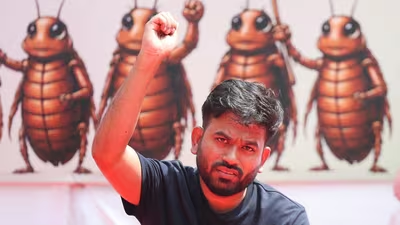
“Thanks for calling us cockroaches.” That was Abhijeet Dipke’s message on Saturday to Chief Justice of India Surya Kant, delivered from the stage at Jantar Mantar, minutes after Dharmendra Pradhan resigned as Union education minister under pressure from the movement that owed its origin and name to a remarks by India’s top judge.
Latest Update
Dipke, then a Boston-based student who had previously worked as a communications strategist with the Aam Aadmi Party, posted a witty response on X the following day. On May 16, he announced the launch of the Cockroach Janta Party, describing it as a platform for “all the ‘cockroaches’ out there”, with eligibility criteria listed as being unemployed, lazy, chronically online, and able to rant professionally.
The satirical post gathered momentum through late May as anger built over the NEET-UG paper leak, and Dipke flew back to India in early June to lead protests near Jantar Mantar in person.
The movement’s central demand — Pradhan’s resignation over the exam irregularities — gained further weight when educator-activist Sonam Wangchuk joined with an indefinite hunger strike on June 28. Wangchuk’s fast ran 26 days before he ended it earlier this week, after the Centre gave written assurances that no cases would be registered against peaceful protesters, that Parliament would take up examination reforms and accountability, and that compensation for the families of students who died by suicide following the alleged paper leak would be considered.
The CJP held firm on Pradhan’s resignation even after Wangchuk’s fast ended, despite a July 20 lathicharge on protesters and a rigid government position that slowly cracked.
Pradhan, in his resignation letter to Prime Minister Narendra Modi, said he was acting “keeping the future of students in mind”, and claimed the decision around ensuring “anti-national elements are not benefitted by the situation at Jantar Mantar and across the country”.
Details
“I would like to thank CJI Surya Kant,” the Cockroach Janta Party founder told supporters, “If he hadn’t called us cockroaches, I wouldn’t have come to India. This movement would not have started.”
The comment traces the movement’s arc back to its origin point, a May 15 Supreme Court hearing on Senior Advocate designation, during which the CJI remarked that “there are youngsters like cockroaches, who don’t get any employment and don’t have any place in the profession”. Kant later said the remark was directed only at holders of fake law degrees, not at unemployed youth broadly.
He has since reiterated that sections of the media misquoted him. The clarifications did little to stop the remark from going viral.
