
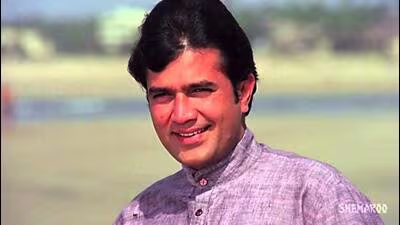
There are actors who perform songs, and then there was Rajesh Khanna, who lived them.
Event Context
Among the melodies picturised on India’s first superstar, a special anthology of tracks revolves around one eternal theme: Zindagi (Life). Each composition reflects a distinct stage, mood, and philosophy of human existence. Khanna’s screen persona was uniquely suited to these songs because he himself represented a paradox, experiencing the dizzying heights of unprecedented hysteria, the painful sting of decline, absolute adulation, and profound loneliness. Through these musical masterpieces, he seemed to converse not merely with his co-stars, but with existence itself.
The journey begins with the carefree, wind-in-the-hair exuberance of Andaz. In “Zindagi ek safar hai suhana”, the message is deceptively simple: Life is a beautiful journey, and tomorrow is entirely uncertain. Riding a motorcycle with absolute abandon, Khanna’s infectious joy urges us not to postpone happiness while waiting for perfect circumstances. Life is not a destination, but the ride itself. The song beautifully stares down the reality of mortality, reminding us that there is nothing to fear in the inevitable: “Maut aani hai aayegi ek din, jaan jaani hai jaayegi ek din, aisi baaton se kya ghabraana.”
If Andaz urges us to ride through life without fear, Anand brings us face-to-face with its ultimate mystery. In “Zindagi kaisi hai paheli”, perhaps no Hindi film song has captured life’s riddle more poignantly. Anand, fully aware of his terminal diagnosis, watches children play by the sea while the lyrics question the stark contrast between their gay abandon and his own battle with an incurable affliction. Happiness and sorrow coexist, the waves come and go, and nothing remains permanent. Life cannot be fully understood; it can only be experienced. The track stands as the perfect musical extension of Anand’s immortal dialogue: “Zindagi badi honi chahiye, lambi nahin.”
This existential contemplation deepens in Safar with “Zindagi ka safar hai ye kaisa safar”. Arguably the most introspective of his songs, it echoes the bewilderment of Anand but with a quiet resignation. The song acknowledges uncertainty and the limits of human knowledge, suggesting wisdom lies in accepting many questions simply have no answers. Yet, even while contemplating the end, it speaks of leaving the world with a smile, noting that though we enter the world crying, we must leave it laughing: “Rote rote zamaane mein aaye magar, hanste hanste zamaane se jaayenge hum.”
But where Safar teaches the grace of acceptance, Aap Ki Kasam confronts the bitter pain of regret. “Zindagi ke safar mein guzar jaate hain” serves as a haunting reminder that moments, relationships, and opportunities once lost rarely return. The emotional core of this song focuses on people rather than time, warning us to value our loved ones before ego, suspicion, and anger destroy what no apology can later restore: “Kuchh log ik roz jo bichhad jaate hain, woh hazaaron ke aane se milte nahin.” The essence of these words only becomes more meaningful with age.
Yet, the journey does not end in bitterness. After the uncertainties and losses of earlier chapters, “Zindagi pyar ka geet hai” from Souten arrives like a gentle conclusion. It is the most optimistic of Khanna’s tracks, framing life as a song of love—sometimes joyous, sometimes sorrowful, but always worth singing. Human existence finds its ultimate meaning not in achievements or material possessions, but in shared emotions.
From carefree road-tripping to serene wisdom, these melodies form a definitive musical buffet on the art of living. As we mark his death anniversary on July 18, the final word inevitably belongs to Anand: “Babu Moshai, zindagi aur maut uparwale ke haath mein hai; hum sab toh rangmanch ki kathputliyan hain.” The curtain will eventually fall on every actor and every audience member. Until then, let us travel, wonder, love, forgive, and sing. Because life, after all, is a beautiful melody whose value lies not in its length, but in the sweetness of the notes we leave behind.
(The writer is a Panchkula-based orthopaedic and former director general of health services, Haryana)
