
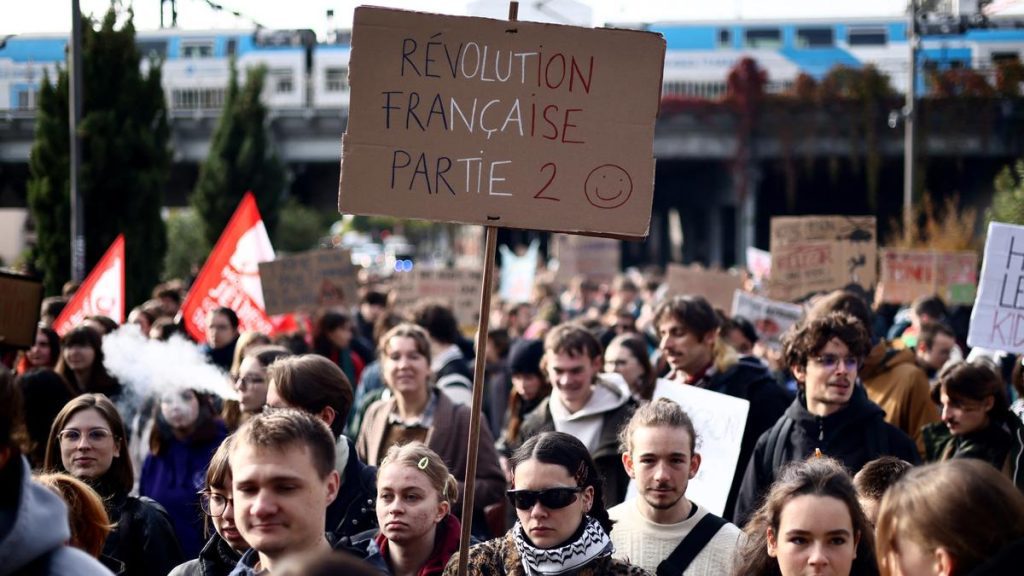
Students blockaded dozens of high schools and universities across France on Tuesday (November 3, 2026) to maintain pressure on the government over education reforms as trade unions prepared for a nationwide strike.
After returning from a two-week autumn break, some students resumed their protest campaign on Monday (November 2), calling on the authorities to renovate dilapidated schools, reduce class sizes and create more university places. Authorities said on Tuesday (November 3) that 48 out of France’s 3,700 high schools were blocked amid tight security, including in Paris, Rennes and Lyon. The USL student union said 500 schools were blocked. Fifty-one higher education institutions out of 184 were also disrupted, officials said.
Last week, the French government unveiled measures aimed at addressing some of the students’ demands, including the replacement of the university admissions platform, which has been criticised for a lack of transparency. With the European Union’s second-largest economy on the brink of recession and under pressure to reduce its debt, authorities have little room to quell student anger with additional spending. ALSO WATCH France protests intensify as anger grows against Macron government
Students say the proposals do not go far enough, demanding 10 billion euros in investment. Student union L’Union Etudiante said one in two was affected on Tuesday (November 3) and that over 50 campuses had been blockaded. At the University of Lille in the north, around 40 students used bicycles and trash bins to block the campus, leading to the cancellation of classes.
The USL union denounced what it called heavy-handed tactics, with “young people pinned against walls and riot police units deployed” outside schools. A union representative said the authorities appeared to want to blunt a new day of blockades when trade unions have called a nationwide strike. “There’s a massive national mobilisation under way,” said Gauthier Capiez, a third-year political science student.

In the northwestern city of Rennes, around 30 students blocked the Brequigny High School, one of the country’s largest secondary schools. On October 17, it also led to some of the worst unrest seen in France in years. On Tuesday (November 3), authorities said three minors had been arrested after a school in the western city of Nantes was set on fire in October, on the margins of the protests.
Thousands of students also marched in Paris and several other cities. Education Minister Edouard Geffray spoke out against the action, saying students needed to study and prepare for exams. Tensions quickly flared between students and the school administration. The school protests have fuelled a nationwide movement against soaring prices and inadequate public services, which has drawn hundreds of thousands of people onto the streets over the past three weekends. Some schools have been damaged since the student movement emerged in September.
“We don’t even have the right to vote, we can’t do anything, so this is our only way of expressing ourselves,” a high school student in northwestern Paris said on condition of anonymity. “Preventing them from entering their school deprives them of a fundamental right: the right to an education,” he said on X, adding that some staff members had “once again been subjected to violence”. “You are not the majority,” a staff member protested. “If we’re doing this, it’s because everything we’ve tried before hasn’t worked,” a student replied. At a school in the southwestern city of Toulouse, students brandished placards, one saying “Angry, not far right”. “Young people are sticking it to the education system,” read another, in a nod to the lyrics of a popular protest song against the far right. The school movement has inspired students in other European countries, including Italy and Spain, where the French word “blocus” (blockade) has become a hashtag. “If next year we manage to get rid of Parcoursup, among other things, then it will all have been worth it,” he said, referring to the university admissions platform.
