
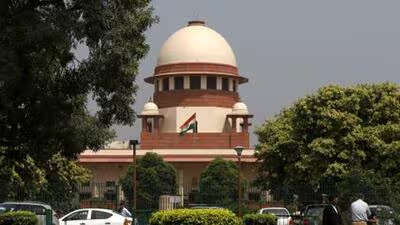
Less than a week after a litigant appearing in person created a ruckus inside a Supreme Court courtroom by hurling papers, using abusive language and disrupting judicial proceedings, the apex court has decided that parties-in-person will ordinarily be encouraged to appear virtually, while those insisting on physical appearance will have to forgo live streaming and video recording of the proceedings.
Latest Update
The move is aimed at preserving courtroom decorum while ensuring that litigants continue to have access to the court. It also seeks to prevent disruptive incidents from being amplified through publicly available live-streams.
Earlier this week, the Chief Justice had unveiled the special roster as part of the Supreme Court’s first structured docket-management exercise to institutionalise disposal of legacy litigation. Around 800 of the oldest civil and criminal matters have already been identified for focussed hearing before the four special benches.
The full court also resolved to simplify the daily cause list and bring greater uniformity in the serial listing of cases. A committee of judges will be constituted to examine these issues and make recommendations.
Reiterating another recent administrative reform, the judges decided that counsel appearing in final hearing matters will continue to furnish advance timelines for their oral submissions, a measure intended to facilitate better case management and more efficient utilisation of court time.
Separately, the full court resolved that all Supreme Court judges would participate in the ongoing Samadhan Samaroh, culminating in a special lok adalat to be held on August 21, 22 and 23, 2026, as part of the court’s broader efforts to promote consensual dispute resolution alongside adjudication.
Details
The decision was taken at a full court meeting of all Supreme Court judges on Wednesday and announced through an official statement on Thursday, in what appears to be the first institutional response by the court to the July 10 disruption, which led to the arrest of two law students after one of them allegedly assaulted security personnel while being escorted out of the courtroom.
The full court resolved that during the interaction with the registrar under the Supreme Court Rules, 2013, parties appearing in person will be given the option to argue their cases through the virtual mode. However, where a litigant insists on appearing physically, “no live-streaming shall be done and video-recording of the proceedings shall also not be permitted”, the statement said.
The decision follows last week’s unprecedented incident in Court No. 13, where petitioner-in-person Prabal Pratap referred to judges as “judicial servants”, hurled abuses, flung papers inside the courtroom and resisted security personnel before being removed.
The bench, led by Justice KV Viswanathan, chose not to initiate contempt proceedings, observing that it was refraining from taking action considering the petitioner’s condition. Delhi Police subsequently arrested Pratap and another law student, Chander Bhan, on charges including assaulting a public servant and obstructing judicial proceedings.
The latest measure also comes months after another courtroom security scare in which a 71-year-old lawyer attempted to hurl a shoe at then Chief Justice Bhushan R Gavai. This incident occurred in October 2025. While declining to initiate contempt proceedings in that case, a bench headed by Justice Surya Kant had at the time emphasised that the court’s focus should be on devising preventive mechanisms rather than punitive measures to ensure that such incidents do not recur.
SC steps up pendency drive
In another significant decision aimed at reducing judicial arrears, the full court resolved to identify and list around 100 bunch matters that are ready for final hearing, with their disposal expected to result in the closure of approximately 9,177 pending cases. These matters will be placed before appropriate benches for out-of-turn hearing.
The initiative complements CJI Surya Kant’s recent overhaul of the Supreme Court’s roster under which four dedicated division benches have been constituted to exclusively hear the oldest civil and criminal matters on Tuesdays, Wednesdays and Thursdays.
The full court further decided that once these identified bunch matters are disposed of, the court will take up the oldest pending cases, after issuance of notice, for hearing on the same three working days every week.
Also Read: ‘Everybody does naare-baazi’: SC on plea to revive protest case against Bhagwant Mann
