
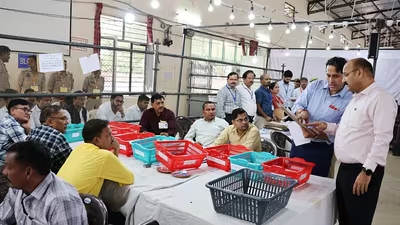
The counting of votes for the Darbhanga Graduates’ constituency in the Bihar Legislative Council elections stretched to 57 hours, with the Election Commission of India (ECI) clearing the result at around 9pm on Thursday, officials said.
The three-day exercise was the longest among the eight constituencies – four each of Teachers’ (Patna, Darbhanga, Tirhut and Saran) and Graduates’ (Patna, Darbhanga, Tirhut and Kosi) that went to polls on October 23. Rashtriya Janata Dal (RJD) candidate Anil Kumar Jha defeated sitting BJP MLC Sarvesh Kumar by 4,010 votes in a contest that saw fortunes fluctuate through several rounds of counting. Jha polled 25,406 votes against Kumar’s 21,396. Mohammad Imteyaz of Jan Suraaj Party (JSP) polled 12,823. With 63,820 valid votes in Darbhanga Graduates’ constituency, the winning quota was 31,911,” Kumar added. “In this case, 37 of the 40 candidates were eliminated, and yet none achieved the winning quota, finally leaving BJP’s Sarvesh Kumar, RJD’s Anil Jha and Mohammad Imteyaz of the Jan Suraaj Party (JSP) in the fray by the process of elimination. At this stage, Kumar led by 1,004 votes until the third-placed Imteyaz’s second-preference votes were transferred to Kumar and Jha, the remaining two leading candidates. The transfer of Imteyaz’s preference votes gave Jha a lead of 533 votes over Kumar to secure a victory,” Kumar said.
“Elections to the Legislative Council’s Teachers’ and Graduates’ constituencies are held under the proportional representation system through the single transferable vote (STV) method. A candidate must secure a prescribed quota of votes to be declared elected. The winning quota is calculated by dividing the total valid votes by two and adding one. As no candidate in the Darbhanga Graduates’ constituency reached the winning quota through first-preference votes, the counting went through the elimination process in which candidates were eliminated one by one, beginning with the lowest tally and their second-preference votes were transferred to the remaining candidates. Once transferred, the votes of the remaining candidates were retotalled, and again, the candidate with the lowest tally was removed while their second-preference votes were transferred to the remaining candidates.
