
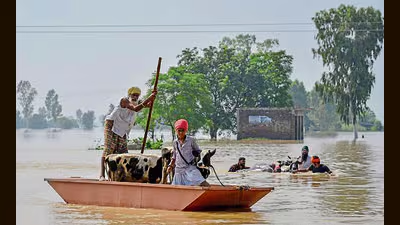
Punjab government’s plan to desilt and remove excess material from Beas and Ravi riverbeds across four districts, aimed at improving flood management and restoring eroded land, has hit a roadblock, with the Centre questioning whether the excavated material could be commercially exploited.
In response, the ministry has asked Punjab to categorically clarify that the work is restricted to flood management and restoration, and does not involve commercial extraction of minor minerals requiring prior environmental clearance. MoEFCC has sought clarification on whether the site falls within the Beas Conservation Reserve or any other protected area, besides asking whether the proposed activity involves commercial extraction, transportation or utilisation of minor minerals. It has sought clarity on their location vis-a-vis the Beas Conservation Reserve and eco-sensitive zones, along with a georeferenced map, details of the quantity and depth of material proposed for removal, excavation methodology, machinery to be deployed, disposal arrangements, and safeguards for the Indus river dolphin and gharial. Despite recommendations by the wildlife warden, chief wildlife warden and the state board’s standing committee, MoEFCC has sought reconciliation of discrepancies relating to the land classification and status of the site.
The proposal for 1.82 hectare near Sidhpur/Bianpur in Gurdaspur has also come under scrutiny. In Hoshiarpur, the ministry has raised questions over proposals at Haler Janardan and Kolian, covering 6.36 hectares and 1.84 hectares, respectively. The 8.57-hectare site near Sangra falls within the Beas Conservation Reserve, which has been designated as a Ramsar site under the aegis of the 1971 Ramsar Convention on Wetlands of International Importance.
Because of their ecological setting, the three proposals in Sultanpur Lodhi, Kapurthala, face particular examination.
The Union ministry of environment, forest and climate change (MoEFCC) has specifically asked the government to ensure that the proposed works do not turn into commercial extraction or utilisation of “minor minerals” (naturally occurring material used mostly for construction) without prior clearance under the Environmental Impact Assessment (EIA) Notification, 2006. A senior officer of the Punjab irrigation department, which will execute the desilting projects, said at Kathlour in Pathankot, the state had proposed removal of flood-deposited material and restoration of eroded land along the Ravi river.
However, before granting clearance, MoEFCC has sought greater clarity on the exact nature and location of the works, their proximity to protected areas and whether the material removed from the river stretches would have any commercial value or use. The intervention comes a month after Punjab’s standing committee of the State Board for Wildlife cleared seven desilting proposals on July 7, before forwarding them to the standing committee of the National Board for Wildlife, the country’s top advisory body for wildlife and forest conservation under MoEFCC, for final approval. The projects, covering about 113.2 hectares in Pathankot, Gurdaspur, Hoshiarpur and Kapurthala, have been proposed primarily to remove flood-deposited material, restore eroded land, and protect nearby habitations and agricultural fields.
What Happens Next
The Beas, which flows for nearly 185 km through Gurdaspur, Tarn Taran, Hoshiarpur and Kapurthala, is among Punjab’s most ecologically sensitive freshwater systems. Because of its biodiversity significance, it was declared a Conservation Reserve in 2017 under the Wildlife (Protection) Act, 1972, and designated a Ramsar site in 2019. Here too, the ministry has sought confirmation that the activity will remain confined to desilting and that the excavated material will not be commercially exploited.
