
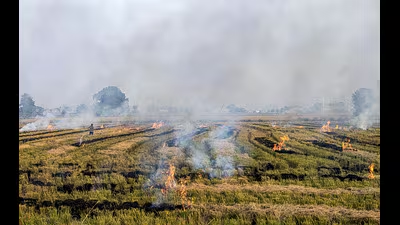
Stubble burning contributes nearly half of the black carbon pollution in rural Punjab, with its share exceeding 90% during peak farm-fire hours, a study by researchers from the Indian Institute of Technology (IIT), Delhi, Postgraduate Institute of Medical Education and Research (PGIMER), Chandigarh, and Panjab University has found. It also highlights how smoke-laden air masses from Punjab are carried by northwesterly winds towards the Indo-Gangetic plain, potentially affecting air quality in downwind regions, including the National Capital Region (NCR).
It provides a quantitative assessment of the contribution of crop-residue burning to ambient black carbon concentrations during the post-monsoon paddy harvesting season. Researchers used advanced monitoring instruments and two statistical techniques — the Aethalometer Model and Positive Matrix Factorisation (PMF) — to identify and estimate the contribution of different pollution sources. However, the researchers cautioned that the findings were based on measurements at a single rural location during one post-monsoon season. They recommended multi-site monitoring, longer-term datasets and further atmospheric modelling to assess the wider regional impact.
Published in the peer-reviewed journal Environmental Monitoring and Assessment this year, the study, titled Ambient black carbon and its dependence on in situ stubble burning, is based on an intensive field campaign conducted at Khera village in Punjab from October 27 to November 18, 2023. Researchers found that crop-residue burning accounted for an average 48% of the black carbon recorded during the study period. Its contribution periodically crossed 90% between 1 pm and 6 pm, coinciding with active burning hours. The monitoring station was set up amid agricultural fields, with the Rajpura Thermal Power Plant located around 10 km away.
