
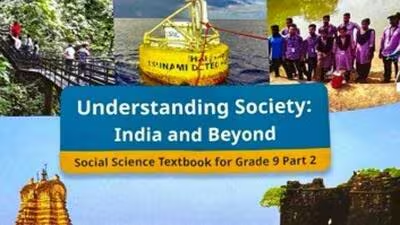
Personal income-tax calculations, government welfare schemes and startup entrepreneurship have been included in the new Class 9 social science textbook part 2 ‘Understanding Society: India and Beyond’.
Indian governance traditions, policy-making and nation-building will be used as central themes in its political science chapters. The political science chapter ‘Governance and Public Policy’, meanwhile, begins with historical symbols of governance and links institutions of government with historical traditions. Startups are subsequently linked to the government’s Viksit Bharat 2047 vision and Atmanirbhar Bharat. The National Education Policy (NEP) 2020 is also used as a case study in policymaking. The political science chapter further uses Khelo Bharat Niti 2025 to explain the role of sport in nation-building, tracing the policy from the Central government to individual citizens.
A quote from Swami Vivekananda — “Arise, awake and stop not till the goal is reached” — introduces a discussion of India’s 120-plus unicorns, with entrepreneurship presented in the context of the country’s development. It brings together the national motto “Satyamev Jayate” from the Mundaka Upanishad, the Supreme Court’s motto “Yato Dharmastato Jayah” from the Mahabharata, and the Sengol, whose lineage is traced to the Chola dynasty and whose installation in the new Parliament building in 2023 is discussed as part of India’s governing traditions. The textbook describes it as an “excellent example” of consultative and evidence-based policymaking, effectively using a major government education reform to explain how public policies are formulated.
