
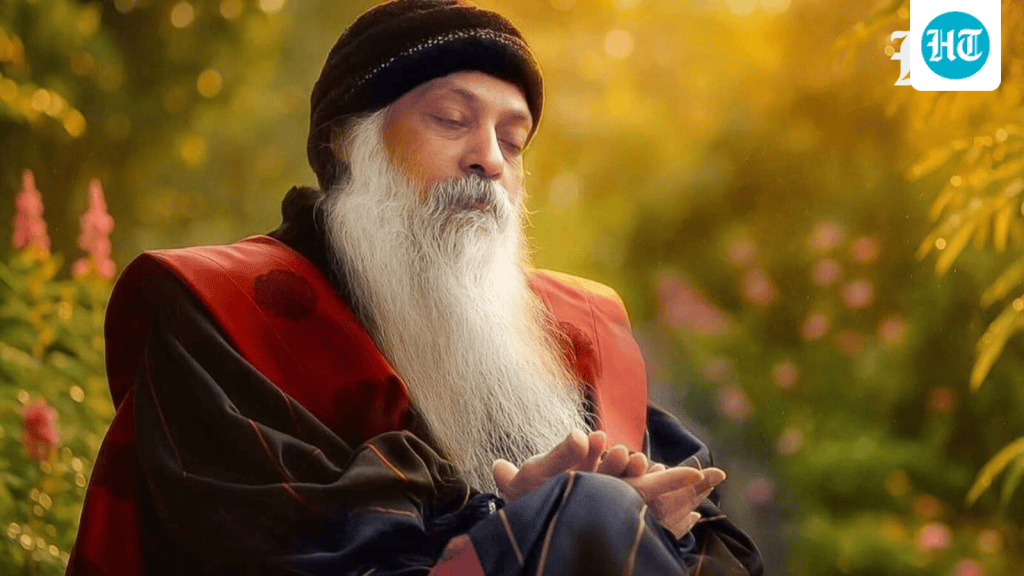
Osho’s teachings often asked people to look beyond fixed beliefs and turn their attention inward. Because he was against the idea of commandments, interestingly, Osho himself acknowledged the contradiction in the request.
His so-called “Ten Commandments,” written in 1970 after he was asked to share ten guiding principles, reflect that approach. He introduced the list by saying he was writing them “just for the fun of it.”
Here is the original list, with the wording checked against published versions of Osho’s letter. The first point asks you to look at authority differently. This line focuses on life as it is experienced rather than on an external idea of God. For Osho, the search for truth was deeply connected to self-awareness. He suggested looking inward rather than constantly searching outside yourself for answers. Love, in this view, is not limited to a particular relationship. It becomes a way of being and relating to life. This points toward letting go of the ego and the constant need to define yourself. The message is simple: your actual experience of life is happening in the present moment, not in the past or in an imagined future. Osho emphasized awareness. This means paying attention to how you think, feel and act rather than moving through life automatically. This is the wording that is sometimes incorrectly written as “swin-float. Published versions of the list give it as “Do not swim, float. The idea is to let go of what has passed instead of carrying every experience forward. Each moment, in this sense, offers the possibility of beginning again. The final point brings the list back to observation. Instead of endlessly looking for something beyond the present, you are asked to pause and see what is already there. Taken together, the commandments are less about following rules and more about questioning the habit of doing so. Their recurring themes are awareness, presence, inner inquiry, love and the willingness to let go of what keeps you from experiencing the present moment. Disclaimer: Osho’s teachings are spiritual and philosophical perspectives and should not be treated as scientifically proven facts. This article is for informational purposes and does not present these teachings as medical, psychological or scientific advice.
Osho, born Chandra Mohan Jain in 1931, was an Indian spiritual teacher and mystic whose talks explored meditation, awareness, love, religion and the nature of existence. He died in Pune in 1990, and his teachings continue to be discussed and practiced internationally. Rather than presenting a strict set of rules, the 10 points encourage you to question, observe and become more aware of your own experience. Osho underlined numbers 3, 7, 9 and 10, giving those points particular emphasis, according to published accounts of the original letter.
Because someone else gives it, Osho encouraged you to notice whether it also feels true to you, instead of following an instruction simply.
“Nothingness” here is presented as a state through which truth can be experienced.
