
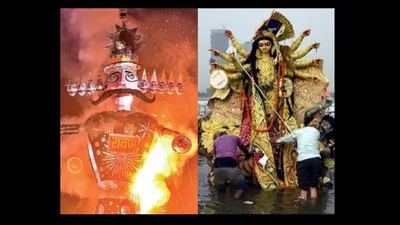
India’s civilisational inheritance reveals itself most vividly in its festivals. They are not merely occasions for ritual, merriment or communal celebration; they are repositories of memory, expressions of collective identity, and reminders of moral truths that a society must continually rediscover. Few festivals illustrate this better than Dussehra, which, under different names and through strikingly different traditions, celebrates two triumphs: the victory of Goddess Durga over Mahishasura in Bengal, and the victory of Rama over Ravana across much of northern India.
The difference is not merely one of mythology. It extends to food, fasting, worship, ritual and the very atmosphere of celebration. In Bengal, Durga Puja is an exuberant public festival in which devotion mingles with art, community and the pleasures of the table. Across much of northern India, the Navratras leading to Vijayadashmi are often observed through fasting, dietary restraint and ritual purification, culminating in the burning of Ravana’s effigy. One celebrates the Goddess with offerings that may include fish; another sees many devotees voluntarily abstaining from meat, fish, eggs and, in some households, particular vegetables. The same sacred season thus accommodates markedly different understandings of how reverence should be expressed. In Bengal, Durga is welcomed as a daughter returning to her parental home, accompanied by her children. The city becomes a vast theatre of devotion and artistic expression. Elaborate pandals, magnificent images, the resonant beat of the dhak, the fragrance of incense and the thronging crowds transform public spaces into temporary temples of collective imagination. The Goddess is worshipped with solemnity, but the occasion is also one of social communion, aesthetic invention and shared pleasure. The ritual is dramatic, but the character of Ravana deserves more than a simplistic division between a virtuous hero and a wicked villain. He is learned, powerful, a formidable ruler and a great devotee of Shiva. His tragedy lies in the fact that extraordinary gifts do not guarantee moral wisdom. Knowledge does not save him from arrogance; power does not restrain his appetite; accomplishment does not excuse his violation of another person’s dignity and freedom. The burning of Ravana should consequently provoke a question more demanding than the ritual itself: what, precisely, are we burning? If Ravana represents pride, greed, lust for power and contempt for the rights of others, his effigy becomes a mirror held up to the present. Evil is easily vanquished in effigy; the arrogance of the powerful, the corruption of public life and the refusal to accept accountability are much harder to overcome.
