
The COEP Technological University and Maharashtra Pollution Control Board (MPCB) recorded an average of 104.5 dB across ten junctions in the area, up from 92.6 dB in 2025. Every junction registered an increase, exposing the gap between the city’s noise-control promises and the sound levels on the street.
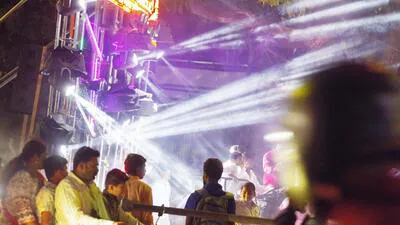
Pune: In spite of public protests and stricter enforcement by police on sound systems, the Ganesh immersion procession was louder in the Laxmi Road area this year compared to last year.
The readings climbed from an average of 98.7 dB at noon on September 25 to 113.4 dB at 4 pm. They remained above 110 dB at 8 pm and midnight, before falling to 85.2 dB by 8 am on September 26. The highest individual reading was 115.4 dB at Gokhale Junction at 8 pm. Holkar Chowk had the highest location-wise average, at 106.8 dB, followed by Shedge at 106.3 dB. Khandujibaba saw the largest increase, from 82.1 dB in 2025 to 104.2 dB this year.
“This year the sound levels are recorded at higher levels at almost all the locations.
The exact reason is yet to be ascertained,” said Mahesh Shindikar, head of COEP’s department of applied sciences and humanities.
Residents also reported the issue in Warje, Sinhagad Road, Senapati Bapat Road, Ambegaon, Dhayari and Kothrud. Bund Garden, Bibvewadi, Sadashiv Peth, Narayan Peth, Warje, Jangali Maharaj Road and Laxmi Road were identified as persistent hotspots across the two years studied. The junction readings suggest some improvement on the final immersion days. Lower readings, however, did not eliminate the noise-limit breaches recorded at pandals. These are partial, immediate observations. The final report is expected within eight to ten days and will be submitted by the MPCB to the authorities concerned for further action. Anti-noise campaigner Vidyanand Bapat had opposed the use of loud sound systems, and hundreds of citizens took to the streets with a similar demand. Pune police subsequently assured stricter action against violations and restricted the size of sound-system setups to four bass and four top speakers. Yet noise levels on the monitored route remained high. One possible explanation offered by observers is the increased use of traditional dhol-tasha troupes where amplified sound systems were more tightly controlled. Drums, too, can add substantially to the sound along a crowded procession route. But the monitoring figures do not separate noise from speakers, drums and other sources, so they cannot establish what caused the increase. These accounts are not covered by COEP’s ten-junction survey. Large tractor-trolleys occupied more than half the road, causing traffic congestion, while loud sound systems added to the disturbance. Residents in the Dhayari–Sinhagad Road area likewise complained that some mandals continued using loud systems despite police warnings.
Noise levels at Ganesh pandals across Pune remained above permissible limits during the 2026 festival, according to MPCB data. the data shows that breaches persisted in both residential and commercial areas Although readings at several locations were lower than in 2025. The study monitored 200 prominent pandals across central Pune and suburban areas for six hours each evening, from 6 pm to midnight. It also tracked noise at 15 major traffic junctions and immersion routes for 24 hours on selected festival days. The preliminary findings report exceedances of 15 to 40 dB(A) against the applicable residential and commercial limits. On the final immersion days of September 24 and 25, 2026, average noise levels at pandals reached 89.9 dB(A), while brief maximum readings rose to 104.5 dB(A). In 2025, daytime average noise reached 105 dB(A) at Jedhe Chowk, Swargate, and nighttime average noise reached 95 dB(A) at Tilak Chowk. The reported 2026 ranges were 69.9–75.4 dB(A) during the day and 64.5–65.6 dB(A) at night. Dhruvi Patil, a student in the Senapati Bapat Road area, said, “A local procession began around 5 pm on September 24 and continued to disrupt the area late into September 25. This year’s 104.5 dB average was the third-highest in its 2001–2026 series, behind 109.3 dB in 2013 and 105.2 dB in 2022, according to COEP.
