
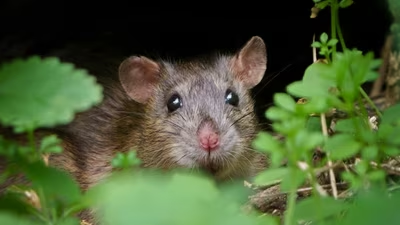
They became unwanted visitors on this group of 25 small islands in the central Pacific, home to seabirds and the broadleaf tree Pisonia grandis. A 2018 PLOS ONE study found that black rats likely arrived in the 1940s, during World War II, and stayed for decades. In June 2011, crews spread bait across the atoll, and by June 2012, monitoring confirmed the rats were gone.
Nobody invited the rats to Palmyra Atoll. The same study notes that Pisonia, a tree where many seabirds nest, rarely grew from seed when rats were present. So, conservationists took things into their own hands and responded with an eradication campaign.
Then came the seedlings. Five of the six native tree species studied showed increased recruitment, although not all gains were statistically significant. Pisonia numbers declined in later years but stayed above zero. Five years is not a long time. The authors warn that the results may only reflect short-term trends and that monitoring must continue. To the best of their knowledge, theirs is the first study to look at seedlings after a rat eradication on a tropical island . So nature did not simply reset itself. Removing one big pressure just opened the door, and what came through still needs watching.
The PLOS ONE paper says more than 99 percent of the rats were gone by July 2011, and monitoring confirmed the atoll rat-free by June 2012. A month after eradication, the researchers tallied as many as 688 Pisonia seedlings per 100 square meters. Before the eradication, in 2004, the team counted 140 seedlings among the five locally rare native trees it tracked, and 7,756 in 2016, according to Island Conservation’s media release on the study.
Two rare native trees, Cordia subcordata and Guettarda speciosa, had no seedlings before the eradication and some afterward, though the difference was not statistically significant.
Both rats and land crabs fed on Pisonia seeds. Palmyra sits roughly 1,000 miles southwest of Hawaii. The authors also cite an earlier experiment in which 99 percent of planted Pisonia seeds did not survive one month. Before the rats departed, the researchers found no Pisonia seedlings in any of their 55 survey strips.
