
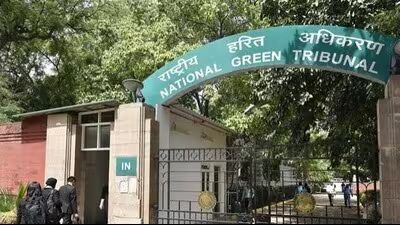
The Union ministry of mines has moved the National Green Tribunal (NGT) seeking deletion of its name from a petition challenging the Punjab government’s river desilting projects, arguing that it has no statutory role in regulating, monitoring, or granting approvals for such activities, which fall exclusively within the jurisdiction of the state government.
Event Context
Player Focus
The ministry, which is responsible for the exploration and development of minerals—excluding coal, petroleum, natural gas, and atomic minerals—and administers the Mines and Minerals (Development and Regulation) Act, 1957, submitted that the Act clearly assigns regulation of minor minerals to state governments.
The affidavit further noted that Punjab has already notified the Punjab Regulation of Crusher Units, Stockists and Retailers Act, 2025, and the Punjab State Minor Mineral Policy, 2025, to regulate the extraction, transportation, and sale of minor minerals. The ministry of mines asserted that it has neither an administrative nor a supervisory role in implementing or enforcing these state-specific laws.
Addressing the petitioner’s principal contention that commercial desilting requires prior environmental clearance, the ministry submitted that such issues fall squarely within the jurisdiction of the MoEFCC and the environmental authorities under the Environment (Protection) Act, 1986, and the EIA Notification, 2006. It maintained that it is neither the nodal agency for granting environmental clearances nor responsible for monitoring compliance with environmental laws.
Team Analysis
Describing its impleadment as a “clear case of misjoinder of parties”, the ministry argued that the petition discloses no cause of action against it and attributes no specific act, omission or statutory violation to the department. It further submitted that retaining the ministry as a respondent would unnecessarily burden a central ministry that has no jurisdiction over the issues under consideration.
source
The application stems from an ongoing environmental dispute in which the NGT, in February this year, stayed desilting operations at several sites across Punjab, including in Ropar district, over concerns that the activity was being undertaken for commercial extraction of minor minerals without obtaining mandatory environmental clearances. The interim order followed a petition challenging the Punjab Water Resources Department’s October 17, 2025, auction notice covering proposed desilting works in Mohali, Patiala, Mansa, Ropar, Ludhiana, Anandpur Sahib and Shaheed Bhagat Singh Nagar districts. The petitioner alleged that the extracted silt and sand were intended for commercial sale, making prior environmental clearance under the Environmental Impact Assessment (EIA) Notification, 2006, mandatory. Concerns were also raised over the potential environmental impact of large-scale excavation, including soil erosion and damage to adjoining agricultural land.
In its reply affidavit, the ministry of mines contended that it had been “unnecessarily and improperly” impleaded as Respondent No. 10 in the case filed by Daljeet Singh. It argued that the issues raised in the petition fall within the legislative and administrative domain of the Punjab government and the ministry of environment, forest and climate change (MoEFCC), and not the ministry of mines.
