
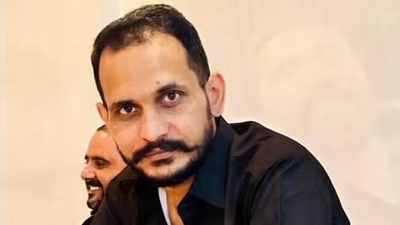
The National Investigation Agency (NIA) has registered a case to investigate the alleged online radicalisation of Indian youths by Pakistan -based gangster Shahzad Bhatti and other suspected Inter-Services Intelligence (ISI) operatives to carry out terror activities in India, news agency PTI quoted unnamed officials as saying.
Two Indian nationals, a resident of Uttar Pradesh named Tushar Chauhan alias Hijbullah Ali Khan, and Sameer, from Delhi, were also named in the case. Both were arrested by the UP ATS in April. Investigators found that Bhatti and other Pakistani operatives allegedly contacted Indian youths through social media and messaging platforms. They are suspected of offering financial incentives to recruit people for activities that could threaten internal security and communal harmony. The alleged network is also suspected of recruiting local operatives to arrange logistics and procure explosives for attacks. Some recruits were allegedly drawn into activities such as threats, extortion, arson and petrol bomb attacks. The Khalistan Liberation Army (KLA) claimed responsibility for the incident through an Instagram post. After a probe the investigators found that the account’s IP address is in Pakistan. The other accused named in the charge sheet are Karamjit Singh alias Tony, Akash, Soureb alias Sobi alias Sourab, Raman Kumar, Sukhdev Singh alias Sukha and Amarjeet Singh alias Ambi. The Union government declared the Shahzad Bhatti Network a terrorist organisation under the Unlawful Activities (Prevention) Act (UAPA) in September. Officials have described him as being linked to the ISI. Security agencies have also carried out operations against the network across several states. The NIA’s wider investigation into attacks on police stations and police personnel in Punjab has pointed to the presence of local groups allegedly working for Bhatti.
The NIA’s investigation into the January 10 blast outside Baldev Nagar police station in Ambala has also revealed how Bhatti allegedly used online platforms to recruit local operatives. The explosion took place on January 10, when a low-intensity improvised explosive device (IED) went off in a Maruti 800 outside the police station. Bhatti, around 45, is a resident of Lahore and is believed to be operating from Brazil . In August, agencies dismantled parts of the network and arrested more than 200 suspects across 14 states.
Uttar Pradesh additional director general of police (law and order) Amitabh Yash had earlier said that Bhatti, Jatt and radical Pakistani YouTubers were allegedly working under ISI instructions to influence Indian youths . The UP police officer said the suspects were allegedly trying to draw young Indians into activities that could disturb peace in the country. The two men arrested by the UP ATS were allegedly in direct contact with Pakistani operatives and were “planning a major disruptive act,” as cited by PTI, according to the news agency report. The Shahzad Bhatti Network (SBN) has used social media to approach young people with offers of employment and money, according to intelligence agencies. In a statement issued in July, the agency said, “some of the accused had parked the car, packed with gas cylinders and explosives substances, in the police station premises and even videographed the scene for dissemination and publicity”. The Centre said the network was involved in terrorism and has participated in various acts of terrorism in India. These groups were tasked with arranging supplies, securing explosives and supporting attacks, officials said according to PTI.
In July, the agency filed a charge sheet against eight people, including the master brain Bhatti and the 25-year-old Satyam. The case follows an investigation by the Uttar Pradesh Anti-Terrorism Squad (ATS) , which registered an FIR in April. The agency had been investigating the presence of Pakistani sleeper cells allegedly created through social media. The NIA’s FIR names eight accused, including Bhatti and several alleged ISI agents based in Pakistan. These include Abid Jatt, Major Hamid, Major Iqbal and Major Anwar, news agency PTI quoted unnamed officials as saying. He also shared his photograph and location with the group. He shared his photograph with the others involved in the conspiracy, who also shared their location. He had keenly agreed to take the vehicle to Ambala. However, Bhatti later asked him to withdraw from the plan after learning that he was travelling with a friend who was driving a taxi. investigators believe he remained connected to the network Although Satyam did not transport the vehicle. The investigation was later handed over to the NIA. The agency also found that a Nokia mobile phone which was manufactured in Pakistan had been used to trigger the explosion. The latest case will examine the alleged online recruitment network and the role of Pakistani operatives in drawing Indian youths into activities linked to terrorism. (With inputs from Neeraj Chauhan and PTI)
The investigation will examine how Pakistani operatives used social media platforms to approach young Indians, offer them money or jobs and allegedly involve them in activities aimed at disturbing peace in the country, according to officials. Satyam had agreed to the task and was added to a Signal group with other accused in the case, according to NIA officials. An official said, “Satyam was even added to a Signal chat group in which other co-accused were members. “However, Bhatti later asked Satyam to back out as the latter was travelling with a taxi driver friend and Bhatti didn’t want to compromise the confidentiality of the plan,” the official added. “Even though Satyam did not take the car to the blast site, he was part of the terror network as he was in regular touch with Bhatti even after the explosion,” a second official said, also seeking anonymity.
