
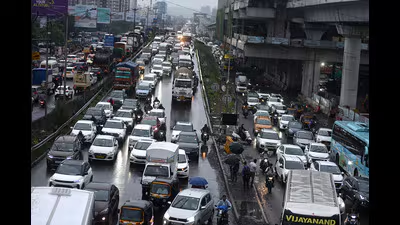
Following severe traffic congestion triggered by heavy rainfall, the National Highways Authority of India (NHAI), Pune, has identified eight critical bottlenecks on national highways in and around the city and is preparing a coordinated action plan with the traffic police and local civic bodies to provide relief to commuters.
Event Context
The major congestion hotspots are identified at Navale Bridge Chowk, Wakad Chowk, Ahmednagar Road Highway, Satara Road Highway, Solapur Road Highway after Hadapsar, along with two other key junctions on the highway network where traffic movement regularly slows down during peak hours and rainfall.
An NHAI senior official, on condition of anonymity, said, “Over the past few weeks, we have carried out inspections at the most congestion-prone locations on the national highway network around Pune. Based on these observations, we have identified seven to eight critical bottlenecks where coordinated intervention is required. We are working closely with the traffic police and civic authorities to implement short-term operational measures while simultaneously planning permanent engineering solutions. We aim to improve traffic flow, reduce travel time and enhance road safety for commuters.”
Senior officials from NHAI, Pune traffic police, Pune Municipal Corporation (PMC), Pimpri Chinchwad Municipal Corporation (PCMC) and other stakeholder departments have begun discussions to prepare location-specific solutions. While short-term interventions will focus on streamlining traffic movement during the ongoing monsoon, the long-term plan will include engineering modifications and infrastructure upgrades designed to permanently eliminate recurring bottlenecks.
Regular commuters said they were relieved that authorities have finally acknowledged the scale of the problem but urged them to execute the plans without delay. “The congestion has become a daily ordeal during the monsoon. At Navale Bridge and Wakad, traffic comes to a complete standstill after even moderate rainfall. If all agencies work together and implement the proposed measures quickly, it will make a huge difference for thousands of commuters,” said Mauli Shinde, an IT professional who commutes between Hinjawadi and Katraj.
Another commuter, Priya Mithani, who frequently travels on Solapur Road, said the situation has steadily worsened over the past few years. “The stretch after Hadapsar witnesses long traffic queues almost every evening, and the rains make the situation much worse. Better drainage, proper traffic management and permanent road improvements are urgently needed. We hope this time the authorities follow through with concrete action rather than temporary arrangements,” she said.
Team Analysis
Among the immediate measures under consideration are improved traffic regulation during peak hours, deployment of additional traffic personnel, removal of roadside encroachments and illegally parked vehicles, better lane discipline through road markings and signage, synchronisation of traffic signals wherever applicable, trimming of roadside vegetation affecting visibility and minor geometric improvements at junctions. Officials also plan to strengthen coordination between highway authorities and civic agencies to ensure prompt removal of stalled vehicles and quicker response during rain-related emergencies.
Match Outlook
The long-term strategy is expected to include widening of carriageways at critical stretches, construction of additional service roads and slip roads, redesign of busy intersections, strengthening of drainage systems to prevent water accumulation, improvements in highway entry and exit points, and other engineering interventions based on traffic studies. NHAI is also expected to undertake periodic traffic assessments so that congestion can be addressed proactively instead of only after it becomes a recurring problem.
source
According to officials, detailed traffic studies are being carried out at each location to determine the most suitable interventions based on traffic volume, road geometry and future growth projections.
