
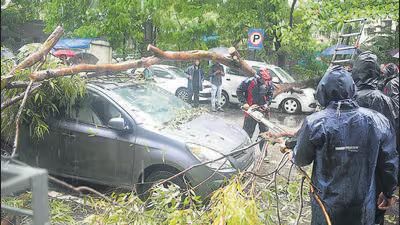
MUMBAI: Are Mumbai’s trees stronger than those in Navi Mumbai? If that seems like an absurd question, let the experts weigh in.
Event Context
In Mumbai, the BMC has consistently cited a stormy monsoon as the primary reason for the city’s trees toppling with alarming regularity. It has firmly refused to admit that pouring concrete around their bases during the city-wide road concretisation drive, now in its third year, has built concrete coffins around their roots, depriving them of nourishment and weakening even the sturdiest species.
Then, on Friday, chief engineer (roads and traffic) Mantayya Swami said something that took tree experts and citizens by surprise. He told HT, “Experts have told us that even if the base of a fully grown tree is concretised completely, it does not pose a risk to the tree falling. Mature trees continue to grow despite concrete around them. It is therefore incorrect to attribute tree falls to concretisation.”
In Navi Mumbai, an expert panel has a diametrically opposite view. Advising the NMMC on tree collapses, it has categorically cited concretisation as the primary reason for the excessive number of tree collapses in July. Despite torrential rain and strong monsoon winds, experts pointed out that more than 90% of tree collapses occur along roads and within housing societies, where excessive concretisation leaves little room for root growth. In contrast, tree collapses are negligible in gaothan and slum areas, where concretisation is relatively limited, the panel said.
Similar weather conditions, neighbouring coastal cities, similar vegetation – diametrically opposite reasons.
The number of trees collapsing is in focus for the excessive number that fell in just one week in early July, and the death of an 11-year-old when a tree toppled in Chembur. The inquiry by senior civic officials that followed exonerated the BMC’s roads and garden departments, triggering a backlash from experts and the public. Even the civic house has rejected the inquiry report.
In Navi Mumbai, experts have also told the NMMC – a special meeting was convened by the civic chief on Friday to discuss the findings – that frequent excavation for utilities further weakens tree root systems, reducing their ability to withstand adverse weather.
Experts say adverse weather is only the trigger for a disaster long in the making.
Both Swami and experts advising the NMMC have also said that phototropism—the tendency of trees to lean towards sunlight—is a contributing factor to tree collapses. In densely built areas, trees grow asymmetrically as they seek sunlight around buildings, creating an imbalance that increases the risk of toppling during storms.
In Navi Mumbai, the expert panel has made another interesting observation. It says that already weakened trees are aggravated by the city’s coastal geography. Waterlogging around tree bases loosens soil, while wet foliage increases the weight of canopies. The high groundwater table adds to the trees’ challenges.
Species-related vulnerabilities are also a factor, the panel said. Some trees have relatively brittle wood and are more prone to branches falling, palm trees have demonstrated greater resilience during storms.
Reacting to the experts’ observations, Navi Mumbai municipal commissioner Kailas Shinde said, “The heavy rains and stormy conditions witnessed during the first week of July affected all metropolitan cities in the Mumbai Metropolitan Region. However, it is important that we scientifically understand why trees are falling in Navi Mumbai and put in place long-term mitigation measures.”
In Mumbai, though, the civic administration has appealed to citizens to avoid standing beneath trees during heavy rain and gusty winds. The challenges, it appears, are beyond human control.
Perhaps that’s why the BMC’s data is so alarming: 902 trees were uprooted across Mumbai, while 1,251 tree branches have crashed since the onset of the monsoon until July 17.
Then, in the 24 hours from Friday to Saturday morning, the tally climbed: eight more instances were reported.
Team Analysis
Which is where scientific pruning – the responsibility of the civic garden department – comes in. However, Swami makes a candid admission. He says pruning is usually carried out only on the side of the tree that faces the road, resulting in an uneven canopy, creating a tendency to lean, and making trees vulnerable to wind stress.
Arborist Dr Nagesh Tekale, remarks: “While phototropism and unscientific pruning are responsible, if a tree is completely concretised at its base, how will water percolate to its roots? Wouldn’t that affect its strength and stability?”
