
Before dawn broke in New Delhi on Saturday (October 10, 2026), tension was palpable at Hazrat Nizamuddin Railway Station as porters and taxi drivers hunted for work, acutely aware of the work they would lose later in the day after the government cancelled dozens of trains.
But at rest stops and parking lots, the workers had one eye on their smartphones as the whispers went around — “the public has awakened now”, “looks like the police are preparing to beat up protesters”, and “all eyes are now on Jantar Mantar”.
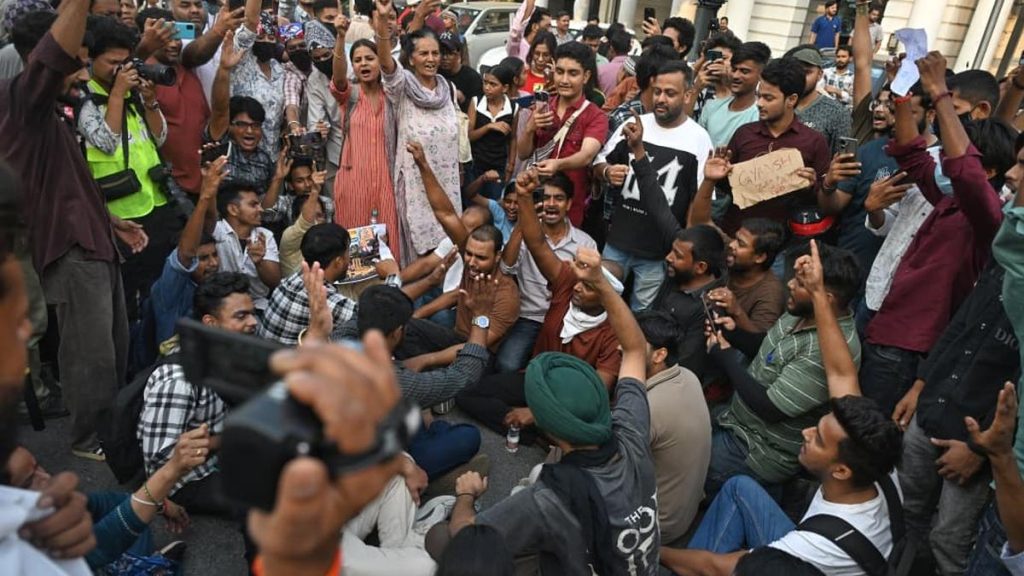
Even as these demonstrations started spreading, senior Delhi Police personnel were seen holding large debriefing sessions with security personnel on how to handle protesters at locations like the Jantar Mantar Road-Ashoka Road roundabout and the Windsor Place circle. Some protesters, even as they were being taken into custody, urged the police to allow them a few moments to record videos or speak to the media. A few asked journalists to record their messages before they were escorted to the detention vehicles. The standoff repeatedly spilled onto the street as protesters emerged from the gurdwara with banners and placards, attempting to resume their demonstration. The police moved in almost immediately, detaining several people and loading them into private buses being used as detention vehicles. Additional personnel, including RAF and Central Reserve Police Force (CRPF) units, were deployed along the stretch as the confrontation continued. The scene soon turned into a cat-and-mouse chase, with young protesters regrouping on the streets before retreating into the gurdwara to evade detention. Each time a group emerged to raise slogans or attempt a brief march, police personnel chased them down and detained several demonstrators.
Even as armed Border Security Force (BSF) arrived at the Hazrat Nizamuddin Railway Station before sunup to monitor exiting passengers, the Delhi Police was fortifying the entirety of New Delhi, especially the designated protest site in the heart of the national capital to prevent ‘Jantar Mantar 2.0’, a protest called by youth organisations, seeking Chief Election Commissioner Gyanesh Kumar’s resignation over alleged special intensive revision (SIR)-linked vote theft. sporadic acts of protest in the early morning hours of Saturday (October 10), wherever they found themselves, by unfurling their posters, raising slogans, and courting detentions by simply smiling their way into buses set the tone for how the day played out across several parts of Delhi While the Delhi Police’s deployment of security personnel across the city made citizens like Geetika feel the need to protest more intensely. As news of Cockroach Janta Party (CJP) leaders Abhijit Dipke, Saurav Das, and Ashutosh Ranka’s detention spread , the Delhi Police had managed to prevent any protester from entering the Jantar Mantar protest site throughout Saturday (October 10), but the protesters themselves had started dispersing and demonstrating wherever they could, for however long they could, and in some cases, just for seconds before they were detained by the police.
The security personnel listened intently, with tear gas munitions hanging from their shoulders and drones flying above their heads as senior officers explained that using force should be the “last resort”.

