
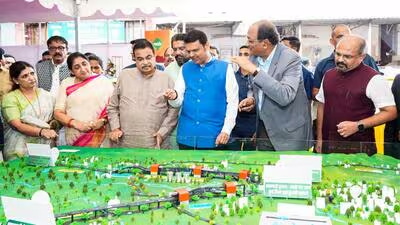
Pune has rarely lacked political heavyweights. It has a Union minister, a Member of Parliament, a deputy chief minister, cabinet ministers and influential MLAs. Yet, when the city faces its biggest crises or its most important infrastructure decisions, the person increasingly seen taking charge is neither the city’s MP (who is also a Union minister with an important portfolio) nor its deputy chief minister, but chief minister Devendra Fadnavis.
Event Context
That says as much about Pune’s leadership vacuum as it does about Fadnavis’ style of functioning.
The past week illustrated this starkly. Heavy rains exposed the city’s fragile infrastructure yet again. The Mumbai-Pune Expressway witnessed severe waterlogging, while a landslide disrupted traffic near the Missing Link project. Thousands of commuters were stranded, and questions were raised about planning and execution.
Every successful MP leaves behind a signature legacy. Pune, unfortunately, has not been fortunate in that regard for well over a decade. Mohol’s predecessors, too, could not provide that transformational push. Girish Bapat’s tenure was cut short by prolonged illness before he passed away, limiting his ability to pursue major projects. Before him, Anil Shirole maintained a low-profile approach and was seldom seen aggressively lobbying for large-scale initiatives for the city. As a result, Pune has continued to grapple with the same familiar challenges, traffic congestion, flooding, public transport gaps, airport connectivity and infrastructure bottlenecks, without a political champion relentlessly pursuing long-term solutions.
Contrast this with what is unfolding at the state level.
Chief Minister Devendra Fadnavis has personally begun chairing high-level committees for three of Pune’s biggest infrastructure projects, the High Capacity Mass Transit Route (HCMTR), the Ring Road and the proposed underground tunnel network. Rather than leaving coordination to departments, he has taken direct ownership of projects that could shape Pune’s growth for decades. This is unusual.
Chief ministers generally intervene only when projects become politically contentious or administratively deadlocked. Fadnavis’ involvement reflects both administrative necessity and political calculation.
Pune is Maharashtra’s second-largest city and one of its biggest economic engines. Delays in its infrastructure have implications far beyond the city. At the same time, Fadnavis has consciously built an image as a leader who delivers large infrastructure projects, from the Mumbai Metro network and coastal road initiatives to the Samruddhi Mahamarg. Successfully pushing through Pune’s long-pending projects would further strengthen that reputation.
Player Focus
But his direct intervention also exposes an uncomfortable reality. Major decisions affecting Pune are increasingly being driven from Mantralaya because no local political leader has emerged as the undisputed face of the city’s development agenda. The Chief Minister appears to have concluded that if these projects are to move at the desired pace, he cannot wait for local political consensus or initiative.
Today’s politics appears increasingly event-driven rather than vision-driven. Public programmes, social media visibility and ceremonial functions have become substitutes for sustained policy advocacy.
The irony is that Pune has never needed strong political leadership more than it does today. The city requires integrated transport planning, scientific flood management, better airport connectivity, new employment hubs and coordinated urban governance.
These challenges demand political ownership as much as administrative efficiency.
Perhaps that explains why Devendra Fadnavis has chosen to step in personally.
Match Outlook
Ordinarily, citizens would expect their elected representatives from Pune to be on the ground, reviewing the situation, coordinating agencies and reassuring the public. Instead, the visible leadership came largely from the administration. Deputy chief minister Sunetra Pawar, despite holding one of the highest offices in the state and representing Pune district politically, remained in Baramati and was not seen leading inspections or review meetings in Pune.
Visibility alone is not governance, but absence during a crisis inevitably sends a message. Many in political circles remarked that this was the kind of situation in which the late Ajit Pawar would have rushed to the spot and taken charge, regardless of whether the issue fell directly under his department.
The larger issue, however, goes beyond one rain event.
Union Minister of State and Pune MP Murlidhar Mohol has remained accessible, active on social media and visible at public events. He has also had to slow down for a period after undergoing leg surgery. More recently, he has also found himself dealing with the political fallout of the Jain boarding controversy, which consumed attention that could otherwise have been devoted to governance. But nearly two years into his parliamentary tenure, Pune is still waiting for a defining vision or a landmark initiative that can fundamentally change the city’s trajectory.
Whether this centralised approach accelerates Pune’s transformation remains to be seen. But it also raises a legitimate question: if the CM has to personally steer every major project in Maharashtra’s second-largest city, what role are Pune’s own political leaders expected to play?
Leadership is ultimately measured not by attendance at public functions but by the ability to define a city’s future.
Pune is still waiting for someone to do exactly that.
