
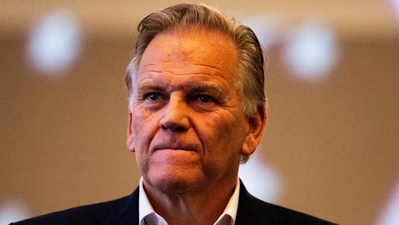
A member of the Republican Party, Mike Rogers is running for the US Senate in Michigan in the 2026 midterm elections. Backed by President Donald Trump , Rogers is seeking to return to Washington after losing the 2024 Senate race to Democrat Elissa Slotkin. He is running against Democratic candidate Abdul El-Sayed , a former public health official. These two candidates have clashed over issues like healthcare, economy and immigration.
Rogers has focused on bringing manufacturing jobs back to Michigan and lowering living costs. He supports tax cuts for working families, reducing regulations and lowering prescription drug prices. During his time in Congress, he supported legislation that expanded healthcare access for low-income families and backed Medicare facilities.
Before entering politics, he worked in a factory and went on to serve in the US Army from 1985 to 1989 and later as an FBI special agent . He entered politics in 1994 and served in the Michigan Senate from 1995 to 2000. He was elected to the US House of Representatives in 2000, representing Michigan’s 8th Congressional District from 2001 to 2015. He went on to chair the House Permanent Select Committee on Intelligence from 2011 to 2015. After leaving Congress, he worked in business and cybersecurity and finally launched his first campaign for the US Senate in 2024.
Describing himself as “pro-life”, he opposes abortion and has an anti-abortion voting record.
Even after aligning himself with President Trump, Rogers has shifted some of his political positions. During his time in Congress, Rogers supported the Patriot Act, which expanded the government’s surveillance powers. He is also known to oppose the Affordable Care Act, commonly known as Obamacare, and supported efforts to repeal it.
He previously criticized Trump’s efforts to challenge the results of the 2020 presidential election. Rogers has an estimated net worth of $14.6 million, according to the Michigan Democratic Party . He accumulated much of his wealth after leaving Congress in 2015, while working in corporate advisory roles, board positions and investments. He and his wife also purchased a home in Cape Coral, Florida, for $1.6 million in 2022.
Rogers supports stricter immigration laws and stronger security along the US-Mexico border. He has backed President Trump’s efforts to increase deportations and give immigration authorities more power to remove people who live illegally in the country. During a debate with Abdul El-Sayed, Rogers defended Immigration and Customs Enforcement (ICE) operations and argued that people who commit crimes should be removed from the country. El-Sayed criticized the administration’s approach, arguing that its enforcement methods could affect people who have not committed crimes. Rogers initially supported the US military campaign against Iran, arguing that the country should not be allowed to develop nuclear weapons. He actively backed President Trump’s decision to launch military action. He argued that ending the conflict would help bring down energy costs. Moreover, El-Sayed has portrayed Rogers as closely aligned with President Trump. The exchange became so heated that the two continued arguing during a commercial break.
However, in September 2026, Rogers called for the war to end quickly, arguing that rising fuel prices have posed a financial burden on American families. Debate moderator Rick Albin said he had never seen candidates continue their argument off-camera in his 30 years of hosting career.
During their October debate, El-Sayed called Rogers a “sock puppet for the Trump administration”, accusing him of prioritizing the president’s agenda over the concerns of Michigan’s people. The personal attacks continued during their television debate where Rogers repeatedly called El-Sayed a “con man” and questioned his medical credentials, while El-Sayed accused Rogers of seeking political power for personal gain.
His change in position drew criticism from El-Sayed, who accused him of changing his stance after previously supporting the war.
