
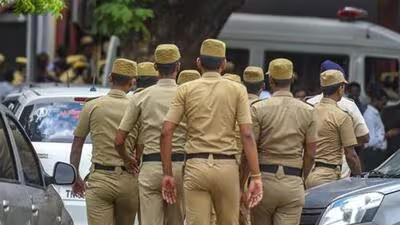
The Madras high court has directed the Tamil Nadu director general of police (DGP) to issue a circular requiring police personnel appearing before courts to wear proper uniforms and maintain “absolute integrity, discipline and devotion to duty”, after a police officer allegedly appeared intoxicated while deposing as a prosecution witness.
Background of the Case
In its July 14 judgment, a division bench of justices SM Subramaniam and N Senthilkumar also directed that if any police personnel, medical officer or other government official appears before a court in a disorderly manner, the presiding judicial officer must report the conduct to the competent authority so that disciplinary proceedings can be initiated.
“Such indifferent attitude of attending Court in a drunken state has to be viewed seriously. Departmental action is purely based on preponderance of probability and his act had totally degraded the image of police force in the Court hall and it has to be curbed, otherwise, the misconduct committed by the respondent will ruin the entire police force,” the court said.
Arumugam had challenged the punishment imposed on him for his conduct while appearing as an official witness before a judicial magistrate.
In 2014, while serving as a special sub-inspector of police, Arumugam appeared as a prosecution witness in a criminal case investigated by him. During his testimony, the magistrate observed “signs of intoxication”, including the “smell of alcohol, incoherent speech, and shouting”, and directed him to undergo a medical examination.
The medical officer recorded the smell of alcohol on his breath and issued a “drunkenness certificate”. Following departmental proceedings, Arumugam was initially awarded compulsory retirement. The punishment was later modified, allowing him to resume duty, but with the stoppage of annual increments for three years.
He subsequently approached the HC, and in 2020 a single judge quashed both the disciplinary proceedings and the punishment. The state challenged that order before a division bench.
Expanding the scope of its directions, the bench said all official witnesses, particularly police personnel, are required to maintain decorum and discipline while deposing before courts and must give truthful evidence. “Any misconduct committed inside a court hall cannot, under any circumstances, be tolerated,” the high court said.
The bench directed the DGP to issue the circular within four weeks. It also instructed the Madras high court Registry to circulate the directions to all courts in Tamil Nadu to ensure uniform compliance with the standards laid down in the judgment.
Team Analysis
The directions came while deciding an appeal filed by the Tamil Nadu government against a single judge’s order that had set aside disciplinary action against police constable V Arumugam.
Allowing the state’s appeal, the division bench set aside the single judge’s order and held that Arumugam’s conduct amounted to serious misconduct that undermined the dignity of the court and the image of the police force.
The bench observed that departmental proceedings are governed by the principle of preponderance of probabilities and that misconduct by official witnesses inside a courtroom cannot be condoned.
The court further held that judicial officers are duty-bound to report any indiscipline, misconduct or unusual behaviour by official witnesses to the competent authority for appropriate disciplinary action.
