
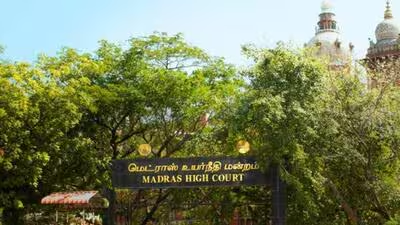
The Madras High Court on Friday directed the Tamil Nadu government to constitute a Special Investigation Team (SIT) to investigate the death of a 24-year-old pregnant woman from Sivaganga district and directed authorities to conduct a fresh postmortem through a neutral medical board.
Event Context
Justice L Victoria Gowri of the Madurai bench of the Madras High Court directed the Director General of Police (DGP) to constitute the SIT within 48 hours with officers not below the rank of Superintendent of Police from the CB-CID or other specialised units.
The judge also directed the police to hand over the entire case records and digital evidence to the SIT.
The high court directed the Director of Medical Education to constitute a “Neutral Medical Board” within 24 hours, adding that “doctors who conducted the earlier postmortem cannot serve on the Board”.
“Pending its constitution, the body has been directed to be preserved at the Government Medical College Hospital, Pudukkottai. The Medical Board has been directed to conduct a fresh postmortem within 48 hours of its constitution,” Justice Gowri said.
The court passed the order on a writ petition and a miscellaneous petition filed by S Fathima Beevi, mother of the deceased, Afrin, seeking transfer of the investigation to an independent SIT and a fresh postmortem to ascertain the real cause of her daughter’s death.
Also Read: Madras HC grants anticipatory bail to Senthil Balaji and brother in r ₹35 crore bribery case
source
According to the petitioner, Afrin married one Mohammed Ashraf on January 25, 2026, and was about four months pregnant when she died. Fathima Beevi alleged that her daughter faced dowry harassment, physical assault and mental cruelty over an additional demand for some gold. She told the court that the circumstances surrounding the death, which occurred within five months of the marriage, required an independent investigation.
The petitioner’s advocate, SK Venkat Raman argued that although the police registered an FIR, they did not conduct a fair or transparent investigation.
He alleged that authorities failed to preserve crucial evidence and did not provide the postmortem certificate, postmortem videography, Inquest Report, forensic reports and other medical records despite repeated requests from the deceased’s family.
The authorities provided the postmortem video and certificate only on June 29 after intervention by the high court.
Advocate Raman said that after examining the postmortem video, the family found that doctors had not conducted the examination in accordance with the guidelines laid down by the court in its 2020 judgement in the case of RM Arun Swaminathan v State. He also said the doctors failed to record injuries visible on the body in the postmortem report.
Raman said the family therefore sought a fresh postmortem in accordance with the court’s guidelines.
