
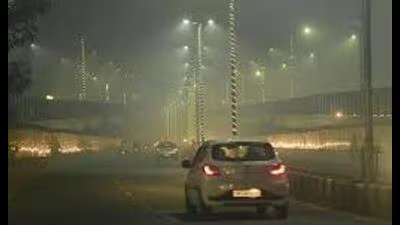
A CSIR-Indian Institute of Toxicology Research (IITR) assessment of nine locations found that both PM10 and PM2.5 concentrations exceeded national permissible limits across all monitoring sites during post-monsoon 2026, with Amausi emerging as the city’s most polluted location. Lucknow has recorded a rise in particulate matter levels, with construction activity, road digging and dust resuspension contributing to the deterioration.
Amausi recorded the highest pollution levels, with average PM10 and PM2.5 concentrations of 188.5 and 93.5 micrograms per cubic metre, respectively. The assessment found that both pollutants increased at most monitoring locations compared to post-monsoon 2025. However, the five-year trend indicates that pollution levels remain below the peak recorded in 2022. PM10 peaked in 2022, with Charbagh touching 330 micrograms per cubic meter, followed by a sharp fall in 2023, fluctuations in 2024-2025 and a moderate rise in 2026. PM2.5 followed a similar pattern: a 2022 peak, a sharp decline in 2023, a rise in 2024, and a further increase in 2026 at all sites except Gomti Nagar. Noise pollution rises across residential, commercial areas Noise levels across Lucknow remained above national standards during post-monsoon 2026, with most residential and commercial locations recording an increase over 2025, according to the CSIR-IITR assessment.
