
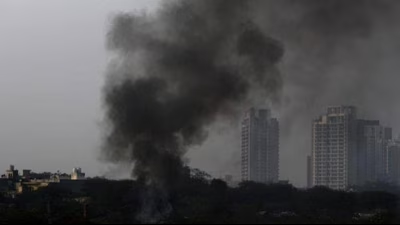
A healthy environment can be attained if systems are in place to take air, water and land quality to the levels they were at during the pre-industrial period or at least to stipulated regulatory parameters. Pollution is on the rise as industrial units are allowing air and water discharge and littering of solid wastes without complete treatment. Industrial areas have failed to come up with common effluent treatment plants, while urban local bodies have failed to establish sewage treatment plants. Some industrial areas have units beyond their carrying capacities. Very few villages, urban and semi-urban areas have means of scientific and efficient solid waste disposal.
Market Context
Metros, cities and towns have human population and vehicles beyond their carrying capacity. Pollution control boards or committees are understaffed with improvements and reforms remaining incomplete or confined to paper. Consequently, air quality has deteriorated. Rivers, streams, seas and oceans are being pumped with untreated urban, agricultural and industrial pollutants, making the water unfit for use and, in some places, carcinogenic. Land is being eroded due to inappropriate waste disposal, following least preferred technologies.
The pollution generated is not only affecting the human health, but triggering climate change.
Environment and pollution laws have recently been decriminalised through the Jan Vishwas (Amendment of Provisions) Act, 2023. Imprisonment for violations under the Air (Prevention and Control of Pollution) Act, 1981, and the Environment (Protection) Act, 1986 has been replaced with higher fines. The Water (Prevention and Control of Pollution) Amendment Act, 2024 contains similar provisions.
Penalties collected under these laws are credited to the Environmental Protection Fund. Fines are based on factors such as the population affected, the frequency and duration of violations, and gains from non-compliance. The stated objective is to promote trust-based governance and ease of doing business. However, these provisions are likely to encourage rather than prevent pollution, as action is taken only after environmental damage has occurred.
Regulations also exempt individual industries in industrial estates from obtaining separate environmental clearances, while industrial estate complexes need no clearance if pollution loads do not increase, without specifying who will verify compliance. This weakens the principle of prevention and instead encourages pollution, requiring urgent correction.
Zero pollution can be achieved only if industrial units receive consent to operate after installing fully functional air, water and other pollution control systems. Zero liquid discharge and reuse of treated wastewater must be ensured. Every industrial area should have a common effluent treatment plant. Water quality in urban and rural water bodies should be monitored regularly, with prompt corrective action taken. The Air Quality Index in urban and industrial areas should also be monitored online.
The treatment of solid waste has the potential to generate energy and wealth and should be fully utilised. Effluent waste should be scientifically disposed of at designated landfill sites, while air quality should be monitored through automated systems. Fish in treated sewerage and effluent tanks can help gauge water quality. Industries should submit self-regulation reports to pollution control boards weekly (red category), monthly (yellow) and quarterly (green), with random verification by regulators.
While penalties may suffice for minor violations, owners of highly polluting units should be prosecuted and fined, with the right to appeal before the adjudicating officer. These measures are essential because rapid economic growth cannot come at the cost of citizens’ right to clean air, safe water and a healthy environment.
(The writer is a retired principal chief conservator of forests, Himachal Pradesh)
Source
Rural areas emerging as pollution hotspots should be addressed through community and gram panchayat participation. Zero pollution requires preventive, source-level pollution management, transparent enforcement, stronger self-regulation by industries, active involvement of gram panchayats and urban local bodies, filling vacancies in pollution control boards, and online monitoring of polluting parameters.
