
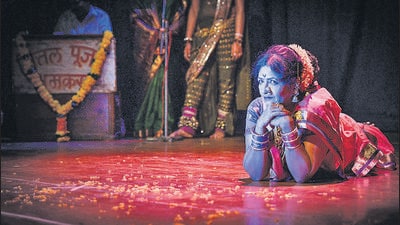
Mumbai: Shakuntalabai Nagarkar, the irrepressible doyenne of lavani and a recipient of the Sangeet Natak Akademi Award in 2008, passed away at 66 at her home in Nimgaon, a sleepy hamlet outside Ahilyanagar, after living with cancer for several years. The lives of women of the Sangeet Bari (a traditional lavani performance circuit in Maharashtra) have been preserved less on paper than through memories and performances, and Shakubai, as she was fondly called, left her own mark with characteristic elan. By the time her life and artistry found their way into a documentary film, book and theatre, she had spent decades mastering and transmitting the form.
When I first encountered Shakubai in Sangeet Bari, the documentary theatre play put together by Bhushan Korgaonkar and Savitri Medhatul in 2013, I was struck by her gestures and entreaties: her eyes would flicker mischievously and the performance would transform as she drew us in with a delicious mixture of immodesty and comic flair. When actor Shernaz Patel handed Shakubai the Best Actress trophy at the Mahindra Excellence in Theatre Awards in 2023, she acknowledged her work in Korgaonkar’s Lavani Ke Rang, and her mastery not just of her form but of the craft of performance too. It was a hilarious sequence, but it also revealed how completely she understood the male gaze that had historically shaped the form.
That play brought Shakubai and her cohorts before urban middle-class audiences, who were a world apart from them, but the show still carried traces of Shakubai’s mainstay—a traditional baithak built around the beautifully tenuous relationship between performer and patron. Lavani artists are often celebrated for their command of shringar, but what Shakubai possessed was a far more expansive understanding of performance. She could lampoon Brahmin priests and boorish customers, become a young girl playing hopscotch, and then, in a rare unguarded moment, sing about unfulfilled desire without any self-parody. Her crowd work was as impeccable as her comic timing; she could be a winsome coquette and an imperious schoolmarm within the same performance, charming and roasting the audience with ease. There was a sharp understanding of gender beneath all this playfulness. In one performance, she put on a coat and topi and became one of those proprietorial men who regard dancers as commodities. In the theatre, some of the men who might once have been ‘customers’ in the Sangeet Bari were now simply spectators, enraptured by a mature sensuality over which they could claim no ownership. In another show, she and her erstwhile malkin or troupe owner Mohanabai Mahalanglekar would heckle each other, and those exchanges were among the most alive and self-aware parts of the evening. By then, Shakubai was managing her own troupe. Neither woman presented herself as a tragic figure carrying the burden of an oppressive tradition on her shoulders. They had spent their lives on the margins, certainly, but they also had enormous vitality and humour.
