
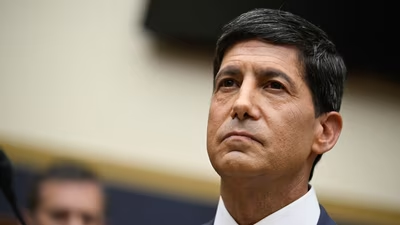
On the evening of June 16, after the first day of his first policy meeting as Federal Reserve chairman, Kevin Warsh sat down to dinner with the 18 officials who set interest rates alongside him. Gathered around a rectangular table, he announced his plan: five panels of outside experts would spend the next few months examining how the Fed reads the economy and explains itself.
Event Context
Before lawmakers, he returned again and again to one number—63 months, the length of time inflation has run above the Fed’s 2% target—to explain why so much needs re-examining. The implication: no one should defend the status quo.
The officials Warsh needs to persuade were in the room for all or some of those 63 months. Some view their record more charitably, and early last year said inflation was returning closer to target, before tariffs and then war in the Middle East stoked new pressures.
The most noticeable change of Warsh’s first two months—one that required no task force or vote—surfaced when a senator used his five minutes of questioning to try, unsuccessfully, to pin Warsh down about his approach.
Sen. John Kennedy (R., La.) walked Warsh through his policy options—hold, hike or cut—before asking how he would decide whether today’s inflation was temporary or permanent. Warsh answered, “You use five task forces to get to the big and hard questions instead of trying to paper it over with policies that have not been proven as successful.”
For Warsh, saying less is a virtue. It protects the committee’s judgment. If policymakers issue a forecast, they start crediting evidence that confirms it and discounting evidence that doesn’t. He also believes a quieter Fed gets a cleaner read on what investors think about the economy, rather than hearing an echo of its own guidance. Investors “are upset with me already that I’m somehow not feeding them all the information they’d gotten before,” he told lawmakers. “My message to them is, ‘Play the ball, don’t play the Fed.’”
The premise doesn’t hold, said Michael Gapen, chief U.S. economist at Morgan Stanley. “It’s a stretch to think that by not commenting on the data, the market will assess the data” with no guess at the Fed’s interpretation of it, he said.
Bullard said Warsh is wise to avoid tipping his hand. He drew a distinction between explaining how the Fed would respond to different scenarios, which he thinks is valuable, and hinting too strongly at a specific move.
Four weeks after the dinner, Waller publicly criticized a tight-lipped approach. “In all my years as an economist, I’ve never seen a single theory that says you make people’s lives better or markets work better if you don’t tell people what you’re thinking,” he told an audience of economists in New York this month. Waller, an appointee of President Trump, was a finalist for the job Warsh won.
Holding invites a different challenge. Warsh has spent two months telling the country the Fed won’t tolerate inflation above its target. A decision to wait, unaccompanied by any account of what would push the committee to act, raises the question of whether the rhetoric will ever be matched by action. Waller framed the concern bluntly this month: “Sternly staring at inflation until it melts before our withering gaze is not an option.”
Write to Nick Timiraos at [email protected]
Team Analysis
The dinner was an early sign of the central tension of Warsh’s chairmanship. He is determined to remake the Fed and convinced it can’t afford to wait. Last year, Warsh persuaded the most rate-cut-hungry president in modern memory to hand the central bank to him despite his long record of worrying about inflation. Now he faces another tricky sale: convincing his colleagues to abandon the intellectual habits of an economics profession he thinks led it astray.
Last month’s dinnertime exchange was, in one sense, exactly what Warsh says he wants: a “good family fight,” in the phrase he uses often, over outcomes not settled in advance. Waller had obliged, insinuating Warsh was importing outside authority to ratify long-held views and dressing them up as discovery.
Warsh brims with confidence. His early verdict, delivered to lawmakers this month: “In six weeks we have caused, I think, a sea change in new thinking.” The 18 governors and reserve bank presidents who, with Warsh, make up the interest rate-setting committee “have received me incredibly warmly,” he said. The culture he wants to instill “is resonating. I hear it back in the hallways. I hear it at the cafeteria.”
Some of that warmth is his doing. Colleagues describe a talent for making people feel valued that succeeds even when they see it coming.
The five Fed task forces—on communications, its inflation framework, and its asset holdings, among others—are meant to reopen questions Warsh believes central bankers and the economics profession had stopped asking. The 15 people chosen to lead them include a Nobel laureate, former central bankers and business executives, and have drawn praise even from skeptics.
James Bullard, who ran the St. Louis Fed from 2008 to 2023, said Warsh has it right. Bringing in credible outsiders to gather input and report back, he said, is how you build support for change in any organization: “I think he’s spot on.”
Committee members have received the task forces with a mix of enthusiasm and reservation. There is genuine interest in revisiting issues like the balance sheet and communications that the Fed has deferred. There is also skepticism over whether Warsh’s ambitious timeline and range of subjects will permit the kind of deliberation a committee this size needs to reach consensus.
Warsh, a Fed governor from 2006 to 2011, has argued for more than a decade that the Fed’s forecasts breed conformity and its data are stale by the time policymakers see them. In a 2016 speech to economists, he questioned the precision the Fed claims in measuring inflation. After an external review he led of the Bank of England’s operations in 2014, Warsh lamented how the Fed’s decision-day discussions had become stilted recitations of prepared remarks—a shift that followed the Fed’s agreement to publish verbatim transcripts in 1993.
Match Outlook
The Fed meets again this week with an outcome that is unusually uncertain. Many expect it to hold rates steady, but a renewed inflation scare has put a surprise increase in play. Part of why it’s so hard to call is Warsh’s signature early move on Fed reform: He is saying less—about the economy, about where policy is headed, about his own thinking—and that silence is generating its own tension.
Warsh says the reviews aren’t designed to impose anything, and that decisions will be left to the committee. The Fed has traditionally been reluctant to have outsiders do this work, and it moves slowly when it does.
William English, a former director of the Fed’s monetary affairs division, doubts the approach can last. A chairman who avoids discussing the outlook can’t explain the committee’s decisions and surrenders a tool for steering it. “Chair Warsh is going to find at some point that he just has to talk about the outlook,” he said.
That moment could arrive Wednesday, when Warsh takes questions following a decision markets couldn’t confidently predict. If the Fed raises rates without saying how far it intends to go, investors could price in a series of hikes the committee doesn’t intend. The remedy, English said, would require Warsh to break his silence and say where he thinks things are headed, by signaling a modest adjustment was more likely than an open-ended hiking campaign.
source
He has said almost nothing about how the Fed reads the shocks now hitting the economy, or how policy should respond. Nor has he been more forthcoming in private: officials who sat through his first meetings came away without a clear sense of how he would approach the trade-offs ahead, according to people who have spoken with them. And where his colleagues describe a trade-off, at least in the short run, between fighting inflation and protecting jobs, Warsh denies there is one.
Several changes the task forces might steer the Fed toward—a modest reduction in its asset holdings, or retiring officials’ quarterly interest-rate projections—are “not a big deal either way” compared with the “more radical” step of declining to describe how the Fed responds to what it sees, said Jon Faust, an adviser to the last three Fed chairs.
