
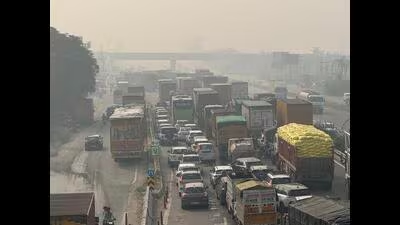
In view of the deteriorating air condition in Delhi, particularly the National Capital Region (NCR), various districts of Haryana have started witnessing poor quality air conditions, with some districts reaching poor to very poor categories.
The Commission for Air Quality Management (CAQM) on Monday invoked GRAP-2 curbs across the NCR region after the Delhi’s air quality reached to ‘very poor’ category for the first time in the season and was recorded at 324. Kaithal district was the most polluted in the state, with an air quality index (AQI) recorded at 310 in the ‘very poor’ category, according to the Central Pollution Control Board’s (CPCB) evening bulletin on Monday. AQI defines the overall air quality like a thermometer running from 0 to 500 degrees with six remarks and colour codes: good/dark green (0-50), satisfactory/green (51-100), moderate/yellow (101-200), poor/orange (201-300), very poor/red (301-400) and severe/maroon (above 401). Similarly, AQI in Dharuhera (298), Ambala (285), Ballabgarh (278), Kurukshetra (258), Gurugram (246), Manesar (211) and Yamunanagar (208) were in the ‘poor’ category. AQI in Sonepat was 161, 112 in Bhiwani, 84 in Panipat, while it was 47 in Karnal — all parts of the NCR. A total of 44 cases have been reported in the state until Monday, which is considerably fewer than the 122 cases lodged last season, according to the consolidated report. The cases of stubble burning were a whooping 838 till date in 2024.
The highest number of cases, seven, have been lodged in Palwal district this year, followed by five in Kaithal, four in Kurukshetra, and three each in Ambala, Hansi, Jind, Karnal and Yamunanagar, according to the report. On the other hand, the state reported two cases of paddy residue burning on Monday with one incident recorded in Ambala and one in Fatehabad.
Places like Sirsa, Rohtak and Panchkula have reported only one case each, the data shows.
Karnal deputy director of agriculture (DDA) Jaswinder Saini said that the department and administration have taken strict action against those burning stubble and are actively monitoring the fields to curb these cases.
