
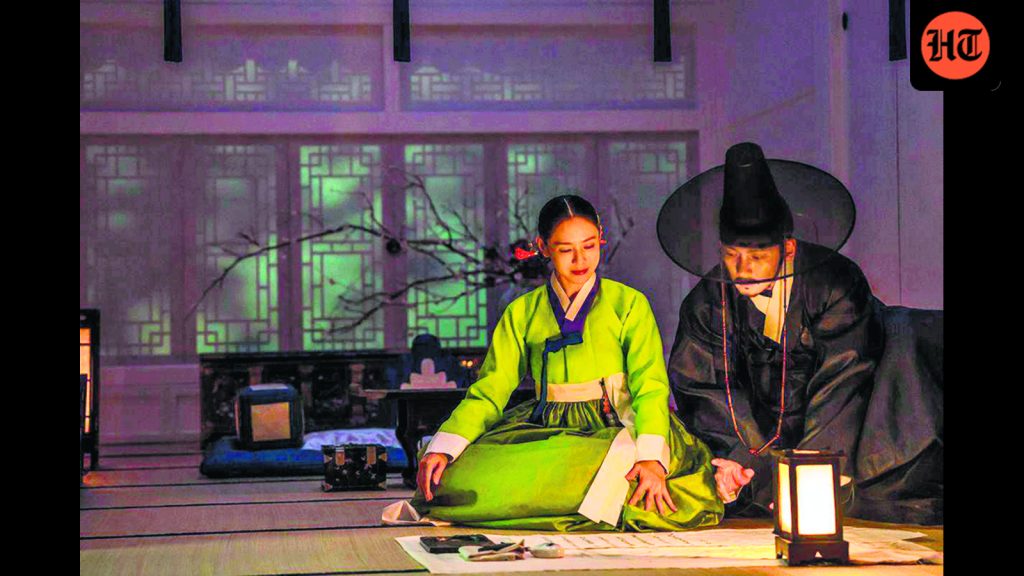
In a curious twist, the most sensual scenes in the new A-rated K-drama, The Scandal, turn out to be not the ones with nude bodies, but the ones in which fully-clothed people read letters out loud.
The written word is arguably the most scandalous thing in the series, which was released on Netflix last week and marks the return of K-drama superstar Son Ye-jin (Crash Landing on You, No Other Choice) after a gap of four years. Jung’s adaptation has left many K-drama fans clutching their pearls over the explicit sex scenes, especially those between Cho Won and Hui-yeon. (The most Son exposes is a single, demure foot.) In fact, those end up feeling like the show’s weakest links, especially when compared with the electric tension that runs through the wordiest scenes. This adaptation is set in the Joseon era, which stretched roughly from the 1400s to the late-1800s. This gives its lead actors a chance to display greater range, since they typically play contemporary characters. The historical setting also allows for a celebration of classical Korean art. One of the cleverest details is director Jung Ji-woo’s use of pansori, a traditional style of singing, which is used like the Greek chorus. The Scandal also uses painted scrolls as a storytelling device, animating details to beautiful effect. The Joseon era is a popular setting for sageuks or historical dramas, which may seem strange since K-dramas are often centred on dynamic women characters, and the second half of this period saw significant restrictions imposed on Korean women. But this actually plays into plots in interesting ways, as writers and directors look back and imagine how ambitious women likely navigated the new challenges. In The Scandal, for different reasons, Cho, her cousin and Hui-yeon are all easy to admire, and equally easy to dislike. The widow’s quivering nervousness is meant to be pathetic, but simply becomes uncomfortable. Son is so good at being unlikeable, it’s a shame the show attempts to draw her character as a tragic anti-hero in its conclusion. There is a suggestion that the real villain is the oppressive society of the time, but there is arguably no age in which her cousin’s callousness and her vicious manipulations would have evoked sympathy. Back to the true delight, words are important in this world. At formal meetings, they are parried with sly subtlety by powerful women like Cho and the Left State Councillor’s wife (Kang Ji-eun), to say one thing and mean another. For the courtesan and businesswoman Bun-hui (Han Sun-hwa), they are blunt but effective weapons. Words make up royal directives as well as tawdry gossip. Put down on paper, they cast a spell of sensual enchantment, turning love letters into precious, coveted secrets. The show offers heartfelt confessions and raunchy comics whose captions add to their brazenness, as well as scribbled notes that reveal as much as they obscure. The views expressed are personal)
Based on the French novel Dangerous Liaisons (1782), the show explores a twisted love triangle between the aristocratic Lady Cho (Son), her male cousin Cho Won (Ji Chang-wook), and a virtuous widow, Ahn Hui-yeon (Nana). The novel has had numerous film adaptations, including Cruel Intentions (1999), starring Sarah Michelle Gellar and Reese Witherspoon; and the award-winning Dangerous Liaisons (1988), with career-defining performances by Glenn Close and John Malkovich. These are often read out, the words alchemising into sound, evoking feelings in both reader and listener. (It’s a pity the subtitles range from awkward to atrocious.) As in Vishal Bhardwaj’s short film in Lust Stories 3 (about a woman who decides to write erotica; the anthology was also released on Netflix last week), it is the written word that proves, in the end, to be the most potent aphrodisiac. (Write to Deepanjana Pal @dpanjana on Instagram.
