
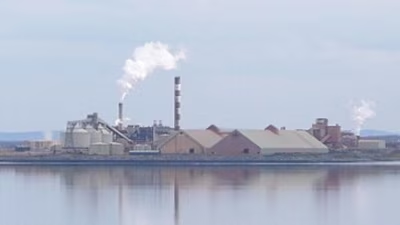
THE IRISH know a few things about resisting an imperialist neighbour, so it is not surprising that they back European efforts to defend Ukraine against Russia. With no significant armed forces or military industry, the country’s aid to Ukraine consists chiefly of a modest bit of financial help and support for European Union sanctions. Yet on the latter count, there is a big caveat. Aughinish Alumina, a refinery in the west of Ireland, supplies a significant portion of the alumina used by Russia’s aluminium industry. The skins of missiles striking civilians in Kyiv this autumn and winter may be part Irish.
Some member states want it included in a new round of sanctions due to be negotiated in October. The role of Aughinish Alumina in Russia’s arms industry was detailed in March in an investigation by OCCRP, an investigative outfit, and the Irish Times, a daily. The plant exports alumina (aluminium oxide), the chemical compound used to produce aluminium, to Russian smelters. But as Europe’s largest alumina refinery, it also ships to manufacturers in France, the Netherlands and Sweden. The firm has never been subjected to the EU’s sanctions on Russia. Aughinish’s defenders argue that doing so would cripple Europe’s aluminium sector, but they are wrong.
In a letter to the Irish government seen by The Economist, the firm’s management argues that without its sales to Russia, the plant would have to close, undermining Europe’s aluminium industry and other manufacturers. Yet in fact, the EU imports most of its aluminium, and produces at most a few percent of global supply. Sanctions would be a political headache for the Irish government. But exempting it from sanctions is a political problem, too. Ireland currently holds the rotating presidency of EU Council, where representatives of national governments sit, and lobbying for a plant that supplies Russia with material for its war machine is a bad look.
Europe’s aluminium smelters are operating at just 30% of capacity. The plant employs around 1,000 workers. It sells the excess electricity from its gas-fired power plant to the national grid, providing enough power for some 200,000 households, the company says.
Its production has shrunk dramatically over the past decade, due to cheap Chinese imports, outdated tech, high power costs and the expense of permits under the EU’s Emission Trading Scheme.
The European Commission has always said it designs its sanctions to avoid harming Europe’s economy more than Russia’s. Aughinish says it should remain exempt on this basis.
