
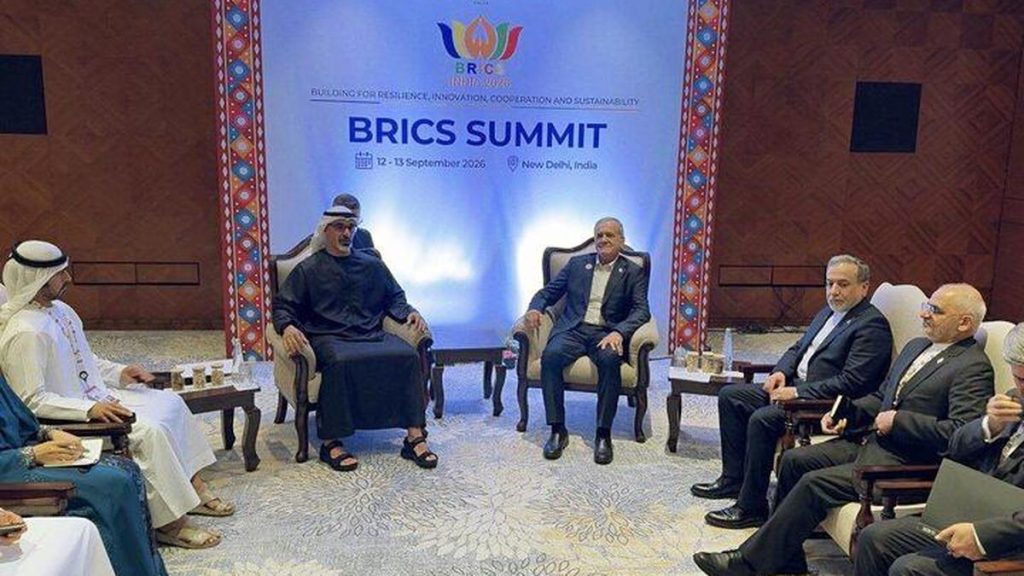
Against the backdrop of continued hostilities in West Asia, Iranian President Masoud Pezeshkian and the Crown Prince of Abu Dhabi, Khaled bin Mohamed bin Zayed Al Nahyan, held talks in New Delhi on Saturday (September 12, 2026) on the sidelines of the 18th BRICS Summit.
The two sides discussed the regional hostilities and expressed support for “de-escalation”.
The conversation came ten days after Iran targeted military installations in the United Arab Emirates (UAE). They also underscored the importance of supporting efforts to ease tensions, promote de-escalation and strengthen regional stability, while advancing opportunities for peace and development for the peoples of the region. Mr.
The ‘New Delhi Declaration’, adopted at the BRICS Summit and announced by Prime Minister Narendra Modi, has expressed “deep concern” about the multiple conflicts in West Asia, but stopped short of naming any of the major stakeholders, including the United States, in the text. The Abu Dhabi Media Office said in a statement, “During the meeting, His Highness and the Iranian President discussed several regional and international issues of mutual interest. Iranian state-owned news outlet IRNA said the meeting was held following “Iran’s consistent calls for and emphasis on strengthening relations with its southern neighbours”. Pezeshkian said on Saturday (September 12, 2026) that West Asia does not need the United States, which is at war with Iran, to be a “regional policeman”. After a meeting with Malaysian Prime Minister Anwar Ibrahim, the Iranian President said, “The territorial integrity and security of the region [West Asia] can only be guaranteed by its main players and the countries that comprise it. The joint statement — the New Delhi Declaration — announced by Prime Minister Narendra Modi expressed “deep concern” over the tension in West Asia while also supporting the “inalienable rights” of the Palestinian people in the Gaza Strip and the West Bank. “We express deep concern over the continued escalation of tensions in West Asia and, recalling our respective national position, call for exercising maximum restraint, as well as avoiding actions that could further aggravate the situation,” said the New Delhi Declaration, highlighting the need to maintain “smooth flow of global trade, supply chains and energy, in accordance with applicable international law”.
The conflicts in West Asia acquired prominence on the first day of the BRICS Summit here on Saturday, with the joint declaration announced at the end of the first day’s leaders’ dialogue dropping any references to the contesting parties in order to reach a consensus.

It did not provide details of any specific outcomes from the meeting. The conversation around West Asia in New Delhi gained further prominence with the arrival of Saudi Foreign Minister Faisal bin Farhan Al Saud on Saturday (September 12, 2026) evening.
The document extended support to the “establishment of a sovereign, independent and viable State of Palestine” within the “internationally recognised 1967 borders that include the Gaza Strip and the West Bank, with East Jerusalem as its capital”. The declaration said that Israel has the “legal obligation” to ensure the supply of “humanitarian aid in Gaza” and called on Israel to respect the terms agreed with the Lebanese government and to withdraw its occupying forces from all Lebanese territories. The External Affairs Ministry had earlier condemned attacks by the Houthi militia on Saudi sovereign territory and civilian and economic facilities, saying that “such attacks that undermined regional security and stability and threatened freedom of navigation in the Bab-el-Mandeb were unacceptable”. Earlier reporting noted: The two leaders discussed regional and international issues, de-escalation, stability, and efforts to promote regional peace and development, the Abu Dhabi Media Office said on X.
Earlier reporting noted: Iran President, UAE Crown Prince meet on BRICS sidelines, back joint statement urging restraint in West Asia war Iranian President Masoud Pezeshkian met Abu Dhabi Crown Prince Sheikh Khaled bin Mohamed bin Zayed Al Nahyan on the sidelines of the first day of the New Delhi summit, marking the highest-level meeting between the two countries since the start of the West Asia conflict. Earlier reporting noted: The meeting came just hours after Iran and the UAE joined other BRICS nations in signing a joint statement calling for restraint in the West Asia war on Saturday, signalling potential diplomatic progress between the two countries amid tensions linked to the conflict.
