
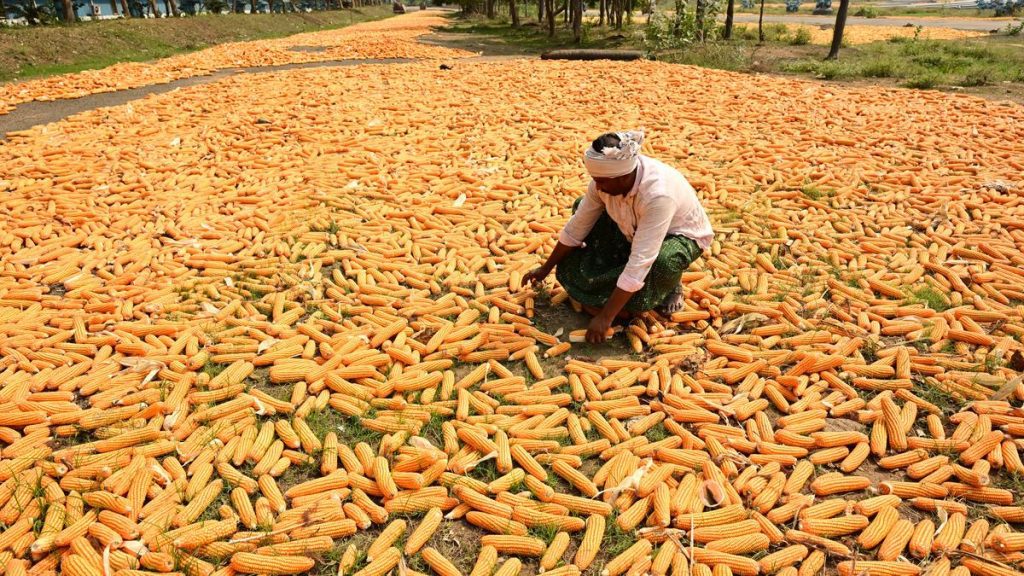
India’s policy of reducing dependence on imported crude is fuelling an import dependence on maize — a product that the country exported until recently.
Maize is now the source of close to half of all the ethanol that India blends into petrol, up from almost nothing three years ago, government data show. This makes it the country’s single-largest raw material used for the production of ethanol. The sugar mills that once profited from the E5 and E10 policy are now seeing diminishing returns. A virtual absence of ‘flex-fuel’ vehicles, capable of running higher-blends of ethanol, means that even producing more ethanol is counterproductive. The country India cites as its model runs the policy differently. In Brazil, the U.S. However, at Indian petrol pumps, E20 sells at the same price as ordinary petrol, roughly half of which is tax.
The government buys ethanol made from maize at a fixed ₹71.86 a litre, the highest rate it pays for any feedstock, according to figures the government submitted to the Lok Sabha . A litre of crude oil, even with the impact of the West Asia crisis , costs the country around ₹55 — the price is under ₹45 in calmer markets. The Ministry of Petroleum and Natural Gas has itself conceded that with crude near $70 a barrel, blending ethanol into petrol costs more than making petrol without it. When the use of surplus rice from the Food Corporation of India and damaged food grains are taken into account, grain feedstock is used to produce nearly 70% of India’s ethanol. In the nearly two decades since India has been using ethanol-blended petrol, rising from 5% in 2006 to 10%, sugarcane has been the prime raw material for ethanol. India hit that target, branded E20, in 2025 — five years early. As recently as 2022-23, India exported maize worth about $764 million. By 2024-25, that had collapsed to roughly $201 million — some 5.5 lakh tonnes, about a quarter of the earlier value — as distilleries absorbed the domestic crop, according to trade data compiled from the Agriculture and Commerce Ministries. In 2024, India became a net maize importer for the first time in decades, buying around 0.9 million tonnes worth some $220 million, much of it from Myanmar and Ukraine. Domestic maize prices have climbed from about ₹15,000 to ₹25,000 a tonne in four years. Prices for the sugarcane-based ethanol routes have been frozen since 2022, even as the guaranteed price that mills must pay cane growers has risen 16.5%. The Indian Sugar and Bio-Energy Manufacturers Association says ethanol from B-heavy molasses, a part-processed sugar stream diverted to the production of fuel rather than crystallised into sugar, now costs about ₹66 a litre to make but sells for a fixed ₹60.73. Balrampur Chini Mills, a leading producer, reported that profit from its ethanol business fell from about ₹326 crore in 2023-24 to ₹192 crore the following year. India’s ethanol-making capacity has reached nearly 2,000 crore litres a year against an annual demand of only about 1,100–1,200 crore litres, leaving distilleries running at roughly half their capacity, according to the Indian Sugar and Bio-Energy Manufacturers Association (ISMA), which estimates about 450 crore litres of capacity is lying idle. Vehicles in Brazil are capable of running ethanol-petrol blends that comprise 85% ethanol and even 100% ethanol, and drivers there buy ethanol only when it is cheap enough to balance the lower fuel economy.
The shift to incorporate maize is part of a deliberate strategy mapped out in the “Roadmap for Ethanol Blending in India 2020-25”, a June 2021 report by NITI Aayog with the Petroleum Ministry, which found that sugarcane alone could not carry the 20% blending target and urged a move to less water-hungry crops such as maize. Department of Agriculture says ethanol prices are set by the market, not the state.
